Product Description
Rheostats
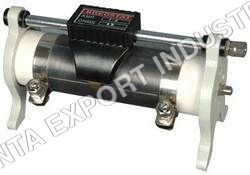
Power Rheostats are made with a variety of resistance & current carrying capacity so as to satisfy every need. They are wound with heavily oxidized eureka resistance wire upon a porcelain tube dia 44 mm aprox. The tube is carrying upon Bakelite rider and the heavy duty sliding contact is of the phosphor bronze with brass rod. 4 mm socket terminals are fitted, allowing for rheostat or potentiometer connection. Total resistance and maximum current capacity is marked on the slider. Total Permanent current loading should not exceed 75% of the marked values. The actual resistance of Wire Wound Rheostats shall be +20% -5% of the rated resistance as per our resistance chart. (as per ISI specification no. IS : 9051 S. No. 10.3), we are recognized as one of the major Electronic Rheostats Manufacturers and Exporters from India
Precision and Durability in Laboratory UseConstructed from high-quality stainless steel, these rheostats promise longevity and robust performance. Their compact dimensions enable easy integration into various laboratory setups, making them suitable for a wide spectrum of scientific applications. Carefully designed resistance mechanisms ensure stable electrical control.
Reliable Voltage Compatibility and PerformanceOperating at 220-240 Volt (v), these rheostats cater to standard laboratory electrical systems. This compatibility facilitates seamless installation and dependable operation, essential for accurate experimentation and data collection in both research and educational settings.
FAQ's of Rheostats:
Q: How are these rheostats typically used in laboratory environments?
A: These rheostats are primarily used to adjust and regulate electrical current in laboratory equipment, aiding experiments that require precise resistance control for accurate measurement and safe operation.
Q: What are the main benefits of using a stainless steel rheostat?
A: A stainless steel construction offers excellent durability, resistance to corrosion, and reliable long-term performance, making the rheostat suitable for rigorous lab usage and harsh chemical environments.
Q: When should I consider replacing or upgrading my laboratory rheostat?
A: Replacement is recommended if the device exhibits signs of inconsistent resistance, physical damage, or difficulty in adjustment. Regular maintenance and periodic inspection ensure optimal performance.
Q: Where can I purchase these laboratory rheostats?
A: You can acquire these rheostats through authorized distributors, exporters, manufacturers, suppliers, or trusted trading companies specializing in laboratory equipment.
Q: What is the process for installing this rheostat into an experimental setup?
A: To install, securely mount the rheostat on a stable surface, connect it to your electrical circuit as specified in the instruction manual, and validate connections before operation to ensure safety and effective current control.
Q: Can these rheostats be used in educational experiments?
A: Yes, their precise control and standard voltage compatibility make them particularly useful for educational labs, supporting a range of experiments that demonstrate principles of resistance and current flow.







 English
 Spanish
 French
 German
 Italian
 Chinese (Simplified)
 Japanese
 Korean
 Arabic
 Portuguese


 Send Inquiry

