Product Description
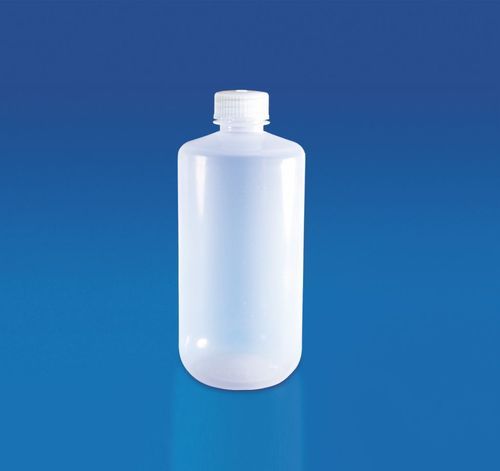
REAGENT BOTTLES (NARROW MOUTH)
These Narrow Mouth Reagent Bottles are available in Polypropylene. The PP bottles are rigid, translucent and have excellent contact clarity. These bottles can be autoclaved filled as well as empty. The Polypropylene Cap has a built in seal ring to make these bottles leakproof.Material : Polypropylene
| PARTICULARS | PACKING |
|---|
| 4 ml. | 100 Pcs. |
| 8 ml. | 100 Pcs. |
| 15 ml. | 100 Pcs. |
| 30 ml. | 12 Pcs. |
| 60 ml. | 12 Pcs. |
| 125 ml. | 12 Pcs. |
| 250 ml. | 12 Pcs. |
| 500 ml. | 12 Pcs. |
| 1000 ml. | 6 Pcs |
Exceptional Chemical and Thermal ResistanceMade from borosilicate glass 3.3, these reagent bottles exhibit excellent resistance to chemicals and thermal shock, making them ideal for laboratory environments. They can withstand rapid temperature changes and repeated autoclaving at 140C, ensuring long-term durability and reusability.
Leak-Proof and Ergonomically DesignedThe narrow mouth design allows controlled pouring, minimizing spills and evaporation. Equipped with a screw cap and liner, the bottles provide a secure, leak-proof seal, even during rigorous transport and storage of volatile or hazardous chemicals.
Versatile Capacities and ApplicationsAvailable in a range of volumes from 60 ml to 2000 ml, these bottles suit diverse laboratory needs. Transparent bottles enable clear observation, while amber options protect light-sensitive compounds. Commonly used for storing, mixing, and transferring chemical solutions in research, industrial, and educational settings.
FAQ's of REAGENT BOTTLES (NARROW MOUTH):
Q: How should I clean and reuse these reagent bottles?
A: Thoroughly wash the bottles with a compatible laboratory detergent, rinse with distilled water, and allow them to dry. Ensure all residues are removed before reuse. They can be autoclaved for sterilization, maintaining their durability and safety for repeated usage.
Q: What makes the screw cap with liner important for laboratory use?
A: The screw cap with liner ensures a tight, leak-proof seal, which is essential for preventing spills, evaporation, and contamination. This secure closure is suitable for transporting and storing volatile or hazardous chemicals safely.
Q: When should I choose amber bottles over transparent ones?
A: Select amber bottles when handling light-sensitive chemicals, as the amber color blocks ultraviolet and visible light, preserving sample integrity. Use transparent bottles for non-light-sensitive reagents to enable easy visual monitoring of contents.
Q: Where can these reagent bottles be used?
A: These bottles are designed for use in laboratories, research facilities, industrial settings, and educational institutions, providing safe storage and handling for a variety of chemical reagents and solutions.
Q: What process is recommended for sterilizing these bottles?
A: Autoclaving is recommended for sterilization. The bottles can withstand temperatures up to 140C, making them suitable for repeated use in high-temperature sterilization cycles commonly employed in laboratories.
Q: What benefits does the narrow mouth design offer?
A: The narrow mouth enables controlled pouring and reduces the risk of spills or splashing, which is especially advantageous when dealing with hazardous chemicals or when precision is required during transfer.







 English
 Spanish
 French
 German
 Italian
 Chinese (Simplified)
 Japanese
 Korean
 Arabic
 Portuguese


 Send Inquiry

