Product Description
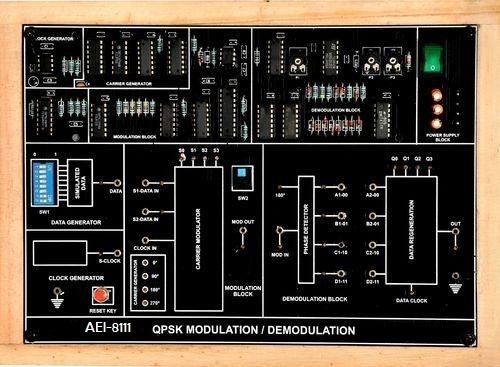
AEI-8111 is a Basic Communication Trainer System to understand QPSK Modulation and Demodulation Techniques. Various functional block diagrams are provided on-board for Teaching/Training. This Trainer provides with various Test Points to visualize the signals on Oscilloscope.
Features:
- A self contained Trainer
- Functional blocks indicated on board mimic Input-output and Test Points provided onboard
- Built in DC Power Supply
- Fully documented operating manual
- All ICs are mounted on IC Sockets.
- Bare board Tested Glass Epoxy SMOBC PCB is used.
- Onboard Data clock generator.
- Onboard Carrier generator.
- Compact Size
- 2 Year Warranty
- Attractive Wooden enclosures of Light weight
- Australian Pine Wood.
Specifications:
- Clock Generator : Synchronous clock generator using IC 555, Frequency of square wave is 200Khz.
- Carrier Generator : Provides Four quadri-phase carrier output generated using IC 7490, 100KHz (0), 100KHz (90), 100KHz (180),100KHz (270)
- Data Generator : Synchronous data generator using IC 74165, Switch selectable simulated data stream, Data stream generated at approx.1Kb/s rate
- QPSK Modulator : using IC 7400
- QPSK Demodulator : using IC 7474 ,TL084, 7486
- Interconnections : 2mm Banana Socket
- Test Points : 25 nos
- Power Supply : 12V/250mA
- Power Consumption : 3 VA approximately
- Dimensions (mm) :W 190xD 279xH 95
- Weight : 2.8 Kg. approximately
- Operating Conditions : 0-40 C, 80% RH
Comprehensive Digital Communication LearningThis trainer covers key aspects of Quadrature Phase Shift Keying (QPSK) modulation and demodulation, with additional reference to BPSK concepts. It provides students and educators with a hands-on platform to observe signal behavior, analyze digital waveforms, and understand complex modulation techniques in a controlled laboratory environment.
Hands-on Experience with Built-in Function GeneratorFeaturing an onboard function generator offering both sine and TTL outputs, users can easily generate required input signals for experiments. Internal generators for BPSK and QPSK ensure seamless operation, while the option for external modulation allows for versatile testing scenarios, thereby fostering deeper learning through real-time practice.
Intuitive Design and Robust ConstructionThe equipment's mild steel structure, compact panel design, and push-button/manual switch controls make it user-friendly and durable. LED indicators reflect logic levels and signal status, while test points and connectors facilitate easy waveform monitoring. This design ensures long-lasting performance in busy laboratory settings.
FAQ's of QPSK Modulation & Demodulation Trainer:
Q: How does the QPSK Modulation & Demodulation Trainer benefit laboratory learners?
A: This trainer enables students to conduct practical experiments on QPSK modulation and demodulation, providing real-time observation via test points and LED indicators. It enhances theoretical understanding through interactive, hands-on learning of digital communication methods.
Q: What processes can be performed using this trainer?
A: Users can perform QPSK and BPSK signal generation, modulation, demodulation, waveform analysis, and signal status observation. The device supports both internal signal generation and external modulating signal input for versatile experimentation.
Q: When should I use the external input feature?
A: The external input option should be used when you wish to analyze the effect of custom or third-party modulating signals, allowing for comparison with internally generated QPSK/BPSK signals and expanded experimental possibilities.
Q: Where can this equipment be applied?
A: This trainer is primarily designed for educational laboratories focused on digital communication, such as electronics or telecommunication labs in universities, colleges, and technical institutes.
Q: How do the LED indicators assist during experiments?
A: LED indicators display real-time signal status and logic levels at key points on the circuit. This aids immediate fault detection, step-by-step procedural checking, and instant feedback throughout the modulation and demodulation process.
Q: What are the key features of the QPSK Modulation & Demodulation Trainer?
A: Key features include a 1 kHz internal carrier, built-in function generator, high-precision signal analysis, 24 test points, LED display indicators, manual controls, mild steel and ABS construction, lightweight and compact rectangular design, and support for external signals.







 English
 Spanish
 French
 German
 Italian
 Chinese (Simplified)
 Japanese
 Korean
 Arabic
 Portuguese


 Send Inquiry

