Product Description
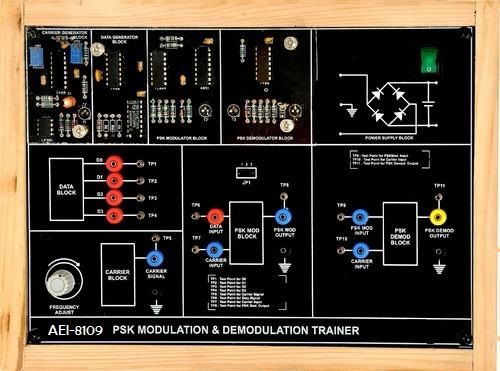
AEI-8109 is a Basic Communication Trainer System to understand Phase Shift Keying Modulation and Demodulation Techniques. Various functional block diagrams are provided on-board for Teaching/Training. This Trainer provides with various Test Points to visualize the signals on Oscilloscope.
Features:
- A self contained Trainer
- Functional blocks indicated on board mimic
- Input-output and Test Points provided onboard
- Built in DC Power Supply
- Fully documented operating manual
- All ICs are mounted on IC Sockets.
- Bare board Tested Glass Epoxy SMOBC PCB is used.
- Onboard Data clock generator.
- Onboard variable Sinewave generator.
- Attractive Wooden enclosures of Light weight
- Australian Pine Wood.
- Compact Size
- 2 Year Warranty
Specifications:
- Data Clock : Four Nos. of using IC 7490
- Sine waveform : 10KHz.-20KHz. With Variable Amplitude of 5Vp-p using Ic2206
- PSK Modulator : Using IC 4051 and IC TL084
- PSK Demodulator : using IC 7486
- Interconnections : 2mm Banana Socket
- Test Points : 3 nos
- Power Supply : 230 V 10%, 50/60 Hz
- Power Supply : 230 V 10%, 50/60 Hz
- Power Consumption : 3 VA approximately
- Dimensions (mm) : W 190xD 279xH 95
- Weight : 2.8 Kg. approximately
- Operating Conditions : 0-40 C, 80% RH
Hands-On Learning for PSK TechniquesThis trainer offers a practical platform for students, researchers, and educators to unravel the intricacies of PSK modulation and demodulation. Designed for accuracy and ease of use, it supports comprehensive demonstrations, enhancing the experimental learning experience in electronics and communications laboratories.
Durable Construction and Reliable PerformanceBuilt from high-quality mild steel, the AEI-8109 is engineered for frequent use in educational settings. Its robust construction ensures long-lasting performance, while its low power requirement (50 W) and standard laboratory voltage (230 V) make it a convenient addition to any electronics workspace.
FAQ's of PSK Modulation & Demodulation Trainer-AEI-8109:
Q: How is the PSK Modulation & Demodulation Trainer-AEI-8109 utilized in a laboratory setting?
A: The AEI-8109 trainer is used in laboratories to simulate and examine the mechanisms of PSK modulation and demodulation. Students connect the device to power, follow the accompanying training modules, and use signal generators and visual displays to observe PSK waveforms and data transmission, facilitating practical understanding of digital communication techniques.
Q: What components are included with the PSK Modulation & Demodulation Trainer-AEI-8109?
A: The trainer typically includes built-in circuits for both modulation and demodulation, necessary connectors and probes, and a comprehensive user manual. Some kits may also provide test points for monitoring signals, making it easier for users to analyze various stages of the PSK process.
Q: When should I consider using the AEI-8109 in my electronics course or laboratory?
A: This trainer is best used during modules or courses focused on digital communications, specifically when exploring modulation schemes. It provides hands-on experience that complements theoretical lectures, especially when covering phase shift keying principles and real-world signal analysis.
Q: Where is the PSK Modulation & Demodulation Trainer-AEI-8109 manufactured and supplied from?
A: The AEI-8109 trainer is manufactured, distributed, exported, and supplied by established companies based in India. These suppliers cater to both domestic and international educational institutions, ensuring quality and support worldwide.
Q: What is the process of PSK modulation and demodulation as demonstrated by this trainer?
A: The trainer generates a modulating signal which is then encoded using phase shift keying (PSK). Users can observe the resulting modulated signal, then see how the demodulation circuit extracts the original data. This step-by-step visual and practical demonstration helps solidify the understanding of PSK concepts.
Q: What are the key benefits of using the AEI-8109 PSK Modulation & Demodulation Trainer?
A: Using this trainer enriches learning by bridging theoretical concepts with real-time experiments. It enhances problem-solving skills, supports detailed analysis of communication signals, and boosts practical knowledge-essential for those pursuing careers in electronics and telecommunications.







 English
 Spanish
 French
 German
 Italian
 Chinese (Simplified)
 Japanese
 Korean
 Arabic
 Portuguese



 Send Inquiry

