Product Description
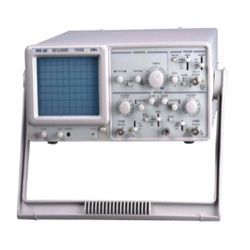
Oscilloscope
We are engaged in offering an exclusive range of Oscilloscopes which are known as type of electronic test instrument that allows observation of constantly varying signal voltages. With the help of our high skill professionals we design these products using high grade components defined as per the industry norm. Oscilloscope offered products are available in different specifications to meet the rigorous needs of the customers.
Features:
Smooth operation
Durability
Sturdy construction
High-Performance Signal AnalysisUtilizing a 100 MHz bandwidth and a sample rate of 1 GS/s, this oscilloscope precisely captures fast-changing electronic signals with impressive clarity and detail. The digital LCD display and multi-trigger options allow for advanced waveform analysis, making it ideal for electronic diagnostics, troubleshooting, and educational demonstrations.
User-Friendly and Versatile DesignDesigned with intuitive digital controls, this compact oscilloscope supports waveform storage and probe attenuation settings for both 1X and 10X. Its ABS plastic housing and rectangular design offer durability and easy handling, while the interface options (USB, LAN, VGA) ensure seamless integration into a variety of workspaces.
Reliable and Durable ConstructionWith a clear glass display, precise signal accuracy (2%), and a durable ABS plastic housing, this instrument provides reliability in laboratory, industrial, and educational environments. Its broad voltage compatibility and temperature resistance make it suitable for a range of operating conditions, guaranteeing consistent performance over extended use.
FAQ's of Oscilloscope:
Q: How do I use the dual channel feature on this oscilloscope?
A: The two channels allow you to simultaneously measure and compare two separate electronic signals. Simply connect your probes to the input ports, select the desired channel using the digital control panel, and observe both waveforms in real time on the LCD display.
Q: What types of triggering modes are available and when should I use them?
A: This oscilloscope offers Edge, Pulse, Video, Slope, and Alternate triggering modes. Use Edge for general waveform capture, Pulse for distinguishing specific pulse widths, Video for analyzing video signal sync, Slope for detecting rising or falling transitions, and Alternate to view both channels alternately. Choose according to your signal characteristics and analysis requirements.
Q: Where can this oscilloscope be used?
A: It is well-suited for electronics laboratories, manufacturing environments, educational institutions, and service centers across India, due to its portability, robust construction, and versatile connectivity.
Q: What is the process for saving and recalling waveforms?
A: To save a waveform, use the onboard digital controls to capture the desired signal, then store it in the oscilloscope's internal memory. You can recall stored waveforms for subsequent viewing and analysis as needed.
Q: How does the high memory depth benefit signal analysis?
A: With a memory depth of 40 Kpts, the oscilloscope captures longer signal segments at high resolution, enabling you to investigate detailed signal anomalies or trends over time for comprehensive analysis.
Q: What advantages does the USB, LAN, and VGA interface offer?
A: USB and LAN ports enable quick data transfer and remote operation, while VGA output allows for external display connections. These features support efficient collaborative analysis and data sharing.
Q: Why is accurate probe attenuation important and how do I use it?
A: Probe attenuation settings (1X, 10X) allow you to adjust signal scaling to match your measurement needs, protecting the device and ensuring accurate readings. Select the relevant attenuation on the probe and oscilloscope before acquiring measurements.






 English
 Spanish
 French
 German
 Italian
 Chinese (Simplified)
 Japanese
 Korean
 Arabic
 Portuguese


 Send Inquiry

