Product Description
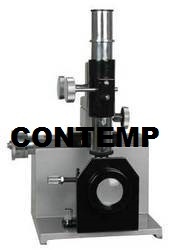
Newtons Ring Microscope
We are well-established as one of the trusted Newtons Ring Microscope manufacturers & Exporters in India. Newtons Ring Microscope offered by us is extensively demanded in the market as no alternative is available in terms of quality and performance.
Features of the Newtons Ring Microscope:-
1. Compact instrument with full arrangements for conducting Newtons Ring experiment.
2. A standard Microscope unit with 30x magnification and rotatable cross line eye piece.
3. Focusing of microscope is through Rack and Pinion.
4. Longitudinal movement of 26 mm is done by rotating the drum provided which reads up to 0.001cm.
5. Complete with optical glass and convex lens inside a metal case.
6. Packed in a sturdy wooden box along with all standard accessories.
Precision Engineering for Reliable MeasurementsThis microscope ensures high-precision, backlash-free vertical movements for exact measurement during Newton's Rings experiments. The robust focusing mechanism, combined with a finely calibrated vernier scale (0.001 mm least count), allows for detailed and reproducible results ideal for scientific research and education.
Superior Optical PerformanceFeaturing an achromatic objective lens made from optically ground glass with anti-reflection coatings, this microscope reduces chromatic aberrations and enhances clarity. The wide field 10X eyepiece and adjustable magnification (50X to 100X) provide clear, distortion-free visualization of interference patterns.
Durability Meets Practical DesignConstructed with a powder-coated, corrosion-resistant cast iron base and a polished metal stage, the microscope is both stable and long-lasting. The manual operation is facilitated by smooth rack and pinion adjustments and finely tuned knobs, making the instrument user-friendly for frequent laboratory use.
FAQ's of Newtonas Ring Microscope:
Q: How is this microscope used in the Newton's Rings interference experiment?
A: The microscope is primarily used to observe and measure the diameters of Newton's Rings formed when a plano-convex lens is placed on a flat glass plate. Its precise focusing system and high-resolution vernier scale allow users to make accurate measurements of the interference rings, which are essential for determining properties like the wavelength of light.
Q: What type of lens and optical quality does this microscope offer?
A: The microscope features an achromatic objective lens made from optically ground glass and coated with anti-reflection material. This combination ensures sharp, clear images with minimal chromatic aberrations, making it ideal for detailed examination of Newton's Rings.
Q: When should the included accessories, such as the calibration glass plate and plano-convex lens, be used?
A: The calibration glass plate and plano-convex lens are specifically used during the Newton's Rings experiments. The glass plate provides a flat surface for interference, while the plano-convex lens is positioned above it to produce the characteristic ring patterns. Use the dust cover to protect the instrument after each session.
Q: Where is this microscope primarily used?
A: This instrument is designed for use in educational and research laboratories, particularly in settings where precision optical measurements are required. Its robust construction and accurate measurement capabilities make it suitable for physics and optics labs across academic and industrial research institutions.
Q: How does the focusing mechanism enhance accuracy during measurements?
A: The microscope's high-precision, backlash-free focusing mechanism-enabled by fine and coarse adjustment knobs-allows for smooth and incremental vertical movement. This ensures that measurements and observations are both accurate and repeatable during experimental procedures.
Q: What are the benefits of the anti-reflection coated optics in this microscope?
A: The anti-reflection coatings on the optical elements significantly reduce glare and unwanted light reflections, resulting in brighter, higher-contrast images. This is particularly beneficial for observing the subtle interference fringes that characterize Newton's Rings.







 English
 Spanish
 French
 German
 Italian
 Chinese (Simplified)
 Japanese
 Korean
 Arabic
 Portuguese





 Send Inquiry

