Product Description
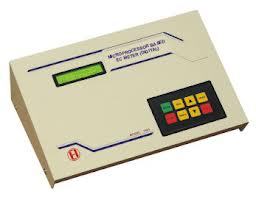
Microprocessor Conductivity TDS Meter
AJANTA EXPORT INDUSTRIES are manufacturer, supplier and exporter of Microprocessor Conductivity TDS Meter.
Specifications:
Conductivity Range:
· 0 to 1000 milli mho in 5 ranges
Range Selection Automatic:
· 0 to 20 micro mho
· 20 to 200 micro mho
· 200 to 2 milli mho
· 2 to 20 milli mho
· 20 to 200 milli mho
· 200 to 1000 milli mho
· Resolution 0.1 micro mho
· Cell Constant Adjustable
· Temperature co-eff. Adjustable between 0 to 4%
· Temperature Comp. Automatic for entire range
· Accuracy +0.5% of range + 1 digit
TDS:
· Range : 0 to 200 ppt in 5 ranges
· Range Selection : Automatic
· Resolution : 0.1 ppm
· TDS Factor : 0.5 and adjustable manually
Salinity:
· Range : 0 to 50 ppt
· Resolution : 0.1 ppt
· Accuracy : +0.5% of range + 1 digit
· Temperature Comp. : Automatic
· Salinity Factor : .75 and Adjustable Manually
Temperature:
· Range -200 TO +200 ºC
· Resolution 0.1 ºC
· Accuracy + 0.2 %
· Input Type Pt 100
· Calibration Manual
· Display : 16 Character * 2 Lines Alphanumeric Lcd.
· Display Format : Temp & Cond Or Temp & Tds, Temp & Sal Simultaneously
· Setting : By Soft Touch Keys
· Storage : 1000 Samples With Date &Time
· Interface : Rs-232, Centronics & Computer
· Real Time Display : 24 Hour Mode With Date
· Error Indication : T- Error, Cal Error
· Power Supply : 230 V ±10% Ac 50 Hz
· Digital Output : A Serial Rs-232
B Parallel Centronics
· Print Format : A All Data
B Date Wise
Advanced Measurement CapabilitiesThis meter covers an extensive measurement range for conductivity and TDS, ensuring accuracy in laboratory and hospital settings. The adjustable cell constant allows for optimal performance across a variety of sample types, while the built-in automatic temperature compensation (ATC) ensures precise readings even as sample temperatures fluctuate.
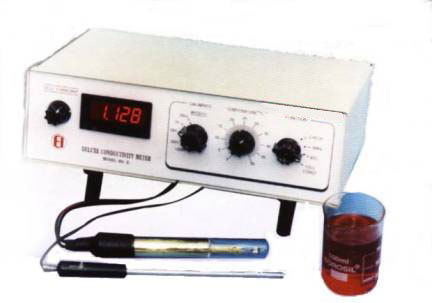
User-Friendly OperationWith automatic single or multi-point calibration options and a responsive microprocessor-based control system, the instrument simplifies both setup and daily operation. The 7-segment LED display provides clear, real-time data ensuring quick and accurate assessment by the user.
Robust Construction and Flexible OutputManufactured with high-quality plastic and metal, the meter is compact yet sturdy, accommodating diverse laboratory workflows. Optional RS232 or printer ports facilitate data output for record-keeping, and the instrument's rectangular design allows it to fit neatly on any bench-top.
FAQ's of Microprocessor Conductivity TDS Meter:
Q: How does the Microprocessor Conductivity TDS Meter ensure accurate results in varying temperatures?
A: The device incorporates both automatic and manual temperature compensation (ATC/MTC) from 0C to 100C, guaranteeing precise conductivity and TDS measurements regardless of sample temperature fluctuations.
Q: What is the process for calibrating this meter and how often should it be performed?
A: Calibration is straightforward with automatic single or multi-point functionality. The frequency depends on usage and required accuracy, but it is typically recommended before each new sample series or according to your lab's standard operating procedures.
Q: Where is this instrument best utilized?
A: This bench-top meter is ideal for hospital and laboratory use where reliable measurement of conductivity and TDS in liquid samples is essential. Its features are optimized for both routine analysis and quality control environments.
Q: What types of samples can be measured with this device?
A: The meter accommodates a wide range of liquid samples, from purified water to highly conductive or concentrated solutions, depending on the selected cell constant and electrode used.
Q: How does the adjustable cell constant improve the instrument's versatility?
A: Adjustable cell constants (0.1, 1.0, 10.0) enable the user to select the optimal sensitivity for different sample types, improving accuracy and allowing one meter to be used for a broad spectrum of applications.
Q: What data output options are available for this meter?
A: The device offers optional RS232 and printer port connectivity, making it easy to log and print results for documentation or further analysis.
Q: What benefits does the microprocessor-based control provide?
A: Microprocessor control enhances data precision, enables automatic calibration, improves response time, and simplifies operation, making the instrument user-friendly and efficient for busy laboratory workflows.







 English
 Spanish
 French
 German
 Italian
 Chinese (Simplified)
 Japanese
 Korean
 Arabic
 Portuguese


 Send Inquiry

