Product Description
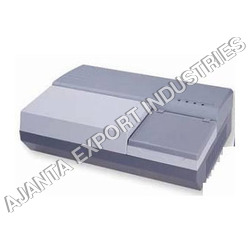
Microplate Reader
We bring forward to our valued customers a comprehensive range of UT-6100 Microplate Readers. Owing to their lamp saving and plate shaking feature, these readers are widely regarded by the clients. Our instruments are adaptable with all external printer supported in windows. With the help of far-reaching distribution network, we have been able to deliver these instruments at clients' destination within the promised time frame.
Some other features of these instruments are listed below:
- PC controlled system & windows XP
- 8-channel optical fibre system enables 5 secreading for 96 wells plate
- Calculation modes include ABS, cut-off, curve, liner, log, exponent, power and 4PL regression
- Up to 12 different tests can be performed in a single plate
- Powerful laboratory management software to store more than 100 programs & 100,000 results
- Powerful QC programs including west guard rules and instant method, automatic alarm
- Multiform test reports output
- Save data automatically when power off unexpectedly
- Powerful internet connection enables remote data sharing and OS update
- Standard English or multi-language software available on request
The Microplate Reader supports endpoint, kinetic, and multi-wavelength photometric analyses, providing compatibility with both 96-well and optional 384-well plate formats. This versatility allows seamless adaptation to various assay requirements, helping laboratories streamline workflow and data collection for a broad spectrum of testing protocols.
Precision and Speed for Laboratory EfficiencyEngineered for accuracy (1% or 0.01 Abs), the device delivers rapid plate readings within 10 seconds. Its interchangeable filter configuration and robust photodiode detection ensure sensitive and consistent results, making it a valuable asset for time-critical laboratory operations involving chemical reactions and assay quantification.
User-Friendly Controls and Robust ConnectivityA microprocessor-based system combined with a large LCD display and straightforward interface ensures smooth operation. The reader's data output options via USB and RS232 enable easy integration with Windows-based software, supporting comprehensive data analysis and traceability for research and quality control needs.
FAQ's of Microplate Reader:
Q: How do I operate the Microplate Reader for endpoint and kinetic measurements?
A: Operation is straightforward via the microprocessor control and large LCD display. Select the desired measurement mode (endpoint, kinetic, or multi-wavelength), insert your 96-well or optional 384-well plate, and follow the on-screen prompts. Results are obtained in under 10 seconds per plate.
Q: What types of plate formats can be used with this Microplate Reader?
A: The standard configuration supports 96-well microplates, but there's also an option for 384-well plates. This flexibility enables use in a variety of laboratory assay formats to address different experimental throughput needs.
Q: When should I use interchangeable optical filters?
A: Interchangeable optical filters are essential when switching between different wavelength analyses within the 400-750 nm range. They help tailor the instrument for specific assays requiring varied detection wavelengths, ensuring optimal sensitivity and accuracy.
Q: Where can I store and export measurement data from the device?
A: Measurement data can be easily stored within the instrument, then exported via the USB or RS232 ports. The Microplate Reader is compatible with Windows-based analysis software, facilitating further data processing, storage, and reporting.
Q: What is the process for maintaining high measurement accuracy?
A: To ensure high accuracy (1% or 0.01 Abs), regularly calibrate the instrument using standard reference solutions. Additionally, operating under suitable environmental conditions-10-35C and humidity 85% RH-helps maintain measurement reliability.
Q: What benefits does the optional incubation module provide?
A: The optional incubation module supports temperature-controlled assays up to 50C, enabling kinetic studies or reactions requiring specific thermal conditions. This feature expands experimental capabilities, especially for enzyme kinetics and temperature-sensitive reactions.







 English
 Spanish
 French
 German
 Italian
 Chinese (Simplified)
 Japanese
 Korean
 Arabic
 Portuguese


 Send Inquiry

