Product Description
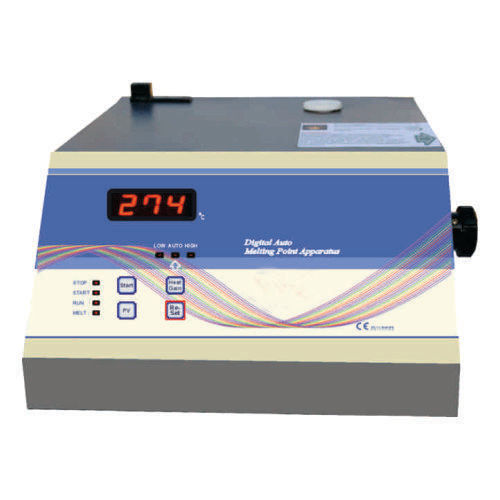
Melting Point Apparatus Automatic
Temp. Range Ambient to 350ºC
Display LCD, 16x2 lines alphanumeric display
Resolution 0.1 ºC
Temp. Sensor Grade A PT-100, Platinum Sensor
Sample Capacity One Sample,Capillary Dimension 1.4mm
Temp. Control Micro process or controlled closed loop PID
Ramp Rates 2ºC to 10ºC/minute (Selectable Auto-Low-High)
Operation Auto determination of Melting Point
Serial Interface RS-232 C to PC
Memory 100 Samples with Location
Power Supply 230V ± 10%AC, 50 Hz.
The instrument basically consists of miniature furnace with Auto controlled heating rate arrangement, an air circulating arrangement and Digital temp. Indication with necessary controls.When the Start key is pressed, heating starts. There is Auto detection of Opto-coupled light transmission system, when sample melts, photo diode detects the signal and Melting Temperature put on hold/latched on display automatically. The furnace becomes off and the cooling fan ON simultaneously.The instrument gives audio & visual indications. The melting temp. of the sample remain displayed on the panel till the RESTE switch is operated. Not suitable for Dark colored samples. Opto-coupled light transmission based,Sample required to be transparent at the time of melting.
Operation : Fully automatic sample Fill and Forget : All the selection of programming is fully protected from power failure including HOLD action for melting temperature. Once the start action is litigated, it will reach to find out the melting point of sample, even multiple time power failure.
Advanced LCD Display for Easy ReadabilityThis apparatus is equipped with a 16x2 lines alphanumeric LCD, offering clear and immediate feedback during operation. The display makes it simple to monitor current settings and melting point results, reducing user error and supporting effective documentation.
Efficient Auto Determination ModeFeaturing an automatic determination process, the device eliminates the need for manual observation, ensuring accurate and repeatable readings. Its automated operation improves throughput and is especially beneficial in busy laboratory environments where precision and efficiency are paramount.
FAQ's of Melting Point Apparatus Automatic:
Q: How does the automatic melting point apparatus operate?
A: The apparatus uses an auto determination method which automatically detects and records the melting point of samples without manual intervention. This ensures precision and reduces the likelihood of human error.
Q: What is the temperature range of this apparatus and what types of samples can it test?
A: The device can measure melting points up to 350C, making it suitable for a variety of chemical, pharmaceutical, and quality control applications where accurate thermal analysis is essential.
Q: When should I use an automatic melting point apparatus instead of a manual one?
A: An automatic model is ideal when frequent, high-volume, or highly accurate melting point measurements are required, as it enhances efficiency, reduces operator fatigue, and minimizes subjective errors associated with manual methods.
Q: Where can I purchase this melting point apparatus in India?
A: This product is available through a network of distributors, exporters, manufacturers, suppliers, and traders throughout India. Contact your preferred laboratory equipment provider for availability.
Q: What is the process for measuring the melting point with this apparatus?
A: Simply prepare your sample, place it into a capillary tube, insert it into the device, and initiate the auto determination process. The apparatus then automatically heats the sample and displays the melting point on the LCD.
Q: How is the 16x2 LCD display beneficial in laboratory settings?
A: The 16x2 alphanumeric LCD display ensures that all relevant data and prompts are easily visible, helping technicians quickly review and confirm results, thereby streamlining workflow and improving data management.
Q: What advantages does automatic determination bring to melting point analysis?
A: Automatic determination offers more consistent and reproducible results, saves time, and reduces operator involvement, making it especially valuable in high-throughput labs and regulated environments.







 English
 Spanish
 French
 German
 Italian
 Chinese (Simplified)
 Japanese
 Korean
 Arabic
 Portuguese


 Send Inquiry

