Product Description
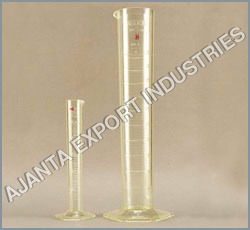
Features- These transparent graduated cylinders have excellent value
- Molded in large neat and easy to read graduations
- Hexagonal shape gives stability to the base
- Cylinders have generous pour spout for smooth flow of liquid during pouring
- Autoclaving at 121o C does not affect accuracy
- Meets accuracy requirements of class A under DIN 12681
- Supplied with conformity test certificate that indicates batch number and year of production that is also marked on the cylinder.
- Measuring Cylinder, TPX Class "A"
| Code | Capacity (ml) | Sub Division (ml) | Error Limit (mm) | Height (mm) | No. Per Case |
| P50501 | 10 | 0.2 | +0.1 | 138 | 1 |
| P50502 | 25 | 0.5 | +0.25 | 169 | 1 |
| P50503 | 50 | 1 | +5 | 198 | 1 |
| P50504 | 100 | 1 | +5 | 258 | 1 |
| P50505 | 250 | 2 | +1 | 314 | 1 |
| P50506 | 500 | 5 | +2.5 | 345 | 1 |
| P50507 | 1000 | 10 | +5 | 411 | 1 |
| P50508 | 2000 | 20 | +10 | 482 | 1 |
Exceptional Chemical and Heat ResistanceConstructed from premium TPX plastic, this measuring cylinder boasts outstanding resistance to acids, alkalis, and organic solvents. Unlike glass, TPX provides not only chemical resilience but also a higher temperature tolerance (up to 175C), making it perfect for demanding laboratory routines requiring sterilization or exposure to corrosive reagents.
Precision Graduation and User-Friendly DesignThe cylinder features a permanent and highly visible graduated scale-available in blue or white-for reliable volume readings. Its hexagonal base ensures stability, preventing accidental rolling, while the anti-drip pouring spout offers safe, precise transfer of liquids. These design elements enhance both accuracy and ease of use in any laboratory environment.
FAQ's of Measuring Cylinder, TPX Class :
Q: How does the TPX measuring cylinder ensure accurate volume measurement?
A: The measuring cylinder is manufactured with a permanent, easy-to-read graduated scale in either blue or white, conforming to DIN/ISO Class A or B accuracy standards. This allows users to take precise volumetric measurements consistently.
Q: What makes TPX plastic a suitable material for laboratory measuring cylinders?
A: TPX (Polymethylpentene) plastic offers transparency like glass but is significantly lighter and highly resistant to most acids, alkalis, and organic solvents. It also withstands higher temperatures (up to 175C), making it ideal for repeated autoclaving and chemical handling.
Q: When should I autoclave the measuring cylinder, and at what temperature?
A: You should autoclave the cylinder as needed for sterilization before or after handling hazardous or biological substances. It can be safely autoclaved at temperatures up to 121C without compromising its structural integrity or accuracy.
Q: Where can these measuring cylinders be used?
A: These TPX measuring cylinders are designed for laboratories in educational, industrial, research, pharmaceutical, and quality control settings, making them versatile tools for any environment requiring precise liquid measurement.
Q: How does the cylinder's design help prevent spills and accidents?
A: The cylinder is equipped with an anti-drip pouring spout for controlled liquid transfer and a hexagonal base that enhances stability, preventing accidental tip-over or rolling, thereby minimizing spills and increasing safety during use.
Q: What are the key benefits of using a TPX measuring cylinder over a glass one?
A: TPX cylinders are lighter, more resistant to chemical corrosion and breakage, and can tolerate higher temperatures. Their durability and ease of handling make them especially advantageous for repeated use in busy laboratory environments.







 English
 Spanish
 French
 German
 Italian
 Chinese (Simplified)
 Japanese
 Korean
 Arabic
 Portuguese


 Send Inquiry

