Product Description
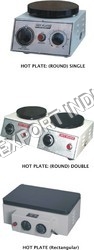
Body is fabricated out of thick mild steel sheet duly finished in white stoving enamel/powder coated paint with mat finished colour combinations. The hot plate made of cast iron or top is made of highly polished stainless steel sheet precisely machined & smoothed duly finished in heat resistant black paint is firmly mounted on the body. Heavy duty heating elements are securely layed under the late to operate on 220 V 50 Hz single phase. Temp. Is controlled by a three-heat rotary switch/energy regulator as per demand. A) HOT PLATE: (ROUND) SINGLE Specification as above with 20 cm (8) dia. mounted top/SS Sheet top. B) HOT PLATE: (ROUND) DOUBLE As per EDI-75 but two plates of 20 cm (8) dia. Having independent Pilot lamps & switches. C) HOT PLATE (Rectangular) As per EDI-75 but plate is rectangular shape. Following Standard size is available: a) 30x25 cm (12'x10') b) 40x25 cm (16'x10') c) 45x30 cm (18'x12') d) 60x45 cm (24x18) OPTIONAL: i) Sunvic energy regulator can be provided against routine energy regulator. ii) Digital temp. Indicator-cum-controller.Sturdy Construction and Optimal InsulationCrafted with either a cast iron or stainless steel top, this hot plate ensures long-lasting performance and excellent heat retention. The powder-coated body shields against corrosion and environmental wear, while thick glass wool or mineral wool insulation minimizes heat loss and keeps the exterior cool to the touch during operation.
Precise Digital Temperature ControlThe integrated digital thermostat allows users to select and monitor temperatures accurately from ambient up to 350C, displayed clearly on the digital readout. This ensures consistent and reliable heating for sensitive laboratory procedures, reducing the risk of thermal fluctuations.
Advanced Safety and Convenient FeaturesSafety is prioritized with overheat protection and an indicator lamp, offering peace of mind during prolonged use. The heavy duty hinged door provides secure access, and the absence of an external piping system simplifies setup, making it ideal for laboratories seeking a safe, efficient solution.
FAQ's of HOT PLATE :
Q: How does the digital thermostat enhance temperature control on the hot plate?
A: The digital thermostat provides precise temperature regulation from ambient to 350C, allowing users to set and monitor exact temperatures. This precision helps ensure uniform heating for laboratory applications, reducing errors and improving experiment consistency.
Q: What materials are used for the top plate, and how do they benefit laboratory work?
A: The hot plate features either a cast iron or stainless steel top, both known for durability and efficient heat distribution. These materials resist corrosion and deformation, making them ideal for demanding lab conditions and ensuring long service life.
Q: When should I use this laboratory hot plate?
A: This hot plate is suitable for applications in chemical, pharmaceutical, and various research laboratories where controlled heating up to 350C is required. Its versatility covers sterilization, drying, sample warming, and other temperature-sensitive processes.
Q: Where can the hot plate be installed in the laboratory environment?
A: Thanks to its compact design (350 x 350 x 150 mm outer size) and no external piping requirement, the hot plate can be conveniently placed on standard laboratory benches or workstations, optimizing workspace usage.
Q: What safety features are included in this hot plate?
A: The unit is equipped with overheat protection and an indicator lamp. Overheat protection automatically shuts off heating in case of excessive temperatures, while the indicator lamp signals operational status, enhancing safe operation.
Q: How is heat uniformity maintained within the hot plate?
A: The hot plate's Nichrome wire heating element and 6 mm thick chamber walls ensure heat uniformity, maintaining a temperature variance as low as 2C at 150C. This consistency is critical for experiments demanding accurate thermal conditions.
Q: What are the main benefits of using this laboratory hot plate over conventional heating methods?
A: Key benefits include precise digital temperature control, safety features, consistent heat distribution, and convenient installation without external piping. These factors enhance experiment reliability, safety, and operational efficiency in laboratory environments.







 English
 Spanish
 French
 German
 Italian
 Chinese (Simplified)
 Japanese
 Korean
 Arabic
 Portuguese


 Send Inquiry

