Product Description
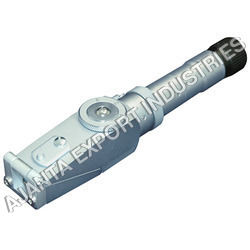
Features:-The refractive index of a solution containing sugar is in proportion to its sugar concentration. The model 500 uses this principle, where a transmitting system is applied, to obtain a high contrast in the field of view. Verification with the 10% Sucrose Solution ( RE-110010 ), 20% Sucrose Solution ( RE-110020 )
30% Sucrose Solution ( RE-110030 ) , 40% Sucrose Solution ( RE-110040 )
50% Sucrose Solution ( RE-110050 ) , 60% Sucrose Solution ( RE-110060 ),
Specifications:- Model:HSR-500, Cat.No.: 2340, Scale range: Brix0.0 to 90.0%
Minimum Scale: Brix 0.2%, Parts:Thermometer for HSR-500 : RE-2340-91H
Thermometer: +1.6 to -1.0 temperature compensation scale, Size & Weight: 4×4×20cm, 600g
Optional: Calibration Certificate, 10% Sucrose Solution (±0.03%) : RE-110010
20% Sucrose Solution (±0.03%) : RE-110020, 30% Sucrose Solution (±0.03%) : RE-110030
40% Sucrose Solution (±0.04%) : RE-110040 , 50% Sucrose Solution (±0.05%) : RE-110050
60% Sucrose Solution (±0.05%) : RE-110060,
Precise Measurements Made SimpleExperience convenience and accuracy with this hand-held refractometer. Designed for field and laboratory use, its automatic temperature compensation provides consistent readings even with temperature changes. Only a minimal sample volume is needed, and results are displayed on an easy-to-read analog scale. Perfect for quality control and research, this reliable tool enhances productivity wherever liquid concentration testing is required.
Portable and User-Friendly DesignEngineered for ease of use, the device features an ergonomic cylindrical shape, adjustable eyepiece, and lightweight build (100-500 grams). It is packaged in a protective plastic case with essential accessories, making it suitable for operators across varying environments. Its manual operation means it requires no external power, ensuring hassle-free usage at any location.
FAQ's of Hand-Held Refractometer:
Q: How do I use the hand-held refractometer to measure Brix or liquid concentration?
A: To use the refractometer, place 2-3 drops of your liquid sample on the optical glass prism, close the cover plate, and look through the eyepiece while pointing the instrument toward a light source. The Brix or concentration is displayed on the analog scale.
Q: What is the process for calibrating this refractometer?
A: Calibration is straightforward-simply place a few drops of distilled water on the prism, adjust the calibration screw until the scale reads zero, and you are ready for accurate measurements.
Q: When should the refractometer be calibrated for optimal accuracy?
A: It is best to calibrate the refractometer before each measurement session or whenever you notice discrepancies in your readings, especially after temperature variation or extended storage.
Q: Where can this refractometer be used?
A: This portable device is suitable for laboratories, food and beverage production, agriculture, wineries, research institutions, and field applications thanks to its lightweight design and robust case.
Q: What are the benefits of automatic temperature compensation (ATC) in this device?
A: ATC ensures your readings remain consistent and accurate across varying ambient temperatures (10-30C), eliminating the need for manual correction and improving reliability.
Q: How does the eyepiece adjustment enhance user experience?
A: The eyepiece can be adjusted for individual focus, allowing clear and precise scale readings regardless of the user's eyesight or lighting conditions.
Q: What materials make up this refractometer, and how does that affect durability?
A: Constructed from PVC, metal, and optical glass, this refractometer is sturdy yet lightweight, offering both durability and ease of handling for extended use.







 English
 Spanish
 French
 German
 Italian
 Chinese (Simplified)
 Japanese
 Korean
 Arabic
 Portuguese


 Send Inquiry

