Product Description
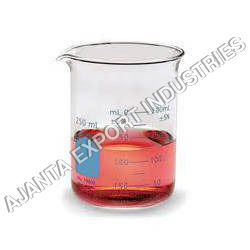
We are manufecture , "SSGW", Brands glassware.This specification provides standard dimensional requirements for glass beakers suitable for general laboratory use. The glass beakers are classified into types and sizes and are presented in details. The glass beaker types are: type I - low form with spout; type II - low form, with spout heavy duty; type III - tall form, with spout; type IV - tall form, without spout; and type V - electrolytic, without spout. Beakers shall be made of boro silicate glass conforming to the requirement specified. Types I and II beakers shall be constructed to have straight sides. Types III and IV beakers shall have slightly tapered sides. Type V beakers may have slightly tapered or straight sides.
Exceptional Chemical and Thermal ResistanceManufactured from high-quality borosilicate glass, this beaker offers remarkable resistance against most chemicals and solvents. Its robust design allows direct heating-whether over a flame or on a hot plate-up to an impressive 400C, making it versatile for many laboratory procedures.
Precision in Measurement and HandlingWith clear graduation markings in milliliters and a flat, stable base, accurate liquid measurement and safe mixing are assured. Its smooth, cylindrical shape and easy-pour spout enable precise transfers, minimizing spillage and ensuring efficient workflow during experiments or analyses.
Reliable and Reusable for Laboratory NeedsThis transparent glass beaker is built for repeated use. It is easy to clean, autoclavable for sterilization, and sturdy against physical and chemical challenges. Its lack of handle streamlines pouring and storage, and it is available in a wide range of volumes to suit varied laboratory applications.
FAQ's of Glass Beaker:
Q: How should I sterilize the Glass Beaker with Graduation Markings for laboratory use?
A: The beaker is autoclavable, meaning it can safely be sterilized using an autoclave at standard conditions. Always clean the beaker thoroughly before autoclaving to remove any residues and ensure optimal sterilization.
Q: What processes is this beaker ideally used for in a laboratory?
A: This beaker is suitable for chemical analysis, laboratory experiments involving mixing and measuring liquids, and transferring solutions. Its precise graduation markings allow for approximate measurement, supporting a range of research and practical applications.
Q: Can the glass beaker withstand direct heating, and if yes, what is the maximum temperature?
A: Yes, this beaker is designed to endure direct heating on a flame or hot plate, withstanding temperatures up to 400C. This makes it ideal for procedures requiring heating or boiling of samples.
Q: Where can I use the glass beaker, and what are its primary benefits?
A: You can use this beaker in educational, research, industrial, and quality control laboratories. Key benefits include its high thermal and chemical resistance, transparency for easy observation, accurate spout for pouring, and reusability for multiple experimental cycles.
Q: What volumes and dimensions are available for this beaker model?
A: The beaker is available in a range of capacities from 50 mL up to 2 liters. Dimensions (length, width, height) vary depending on the model and volume, accommodating different laboratory requirements.
Q: How accurate are the graduation markings on the beaker?
A: The graduation markings on the beaker provide approximate measurements in milliliters, suitable for general laboratory work. For critical quantitative analysis, use more precise volumetric glassware.







 English
 Spanish
 French
 German
 Italian
 Chinese (Simplified)
 Japanese
 Korean
 Arabic
 Portuguese


 Send Inquiry

