Product Description
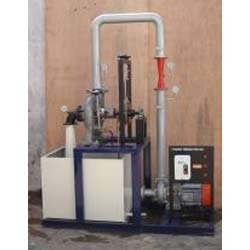
We offer excellent Francis Turbine Test Rig to the customers. These reaction turbines are made available to the clients at highly competitive prices and in varied specifications. Moreover, our clients can avail these products from us in customized forms that are designed as per the exact details provided by the clients.
Features:
- Extremely reliable and accurate
- Satisfying performance
- Well equipped with all the necessary operating tools
- Long lasting
- Available at cost efficient price range
Other Details:
Water enters the turbine though outer periphery of the runner in and leaves the runner in axial direction
When water flows to the the runner, a part of pressure energy changes to kinetic energy
Water is completely enclosed in an air tight casing
The casing & runner is always full of water
Present set-up has a runner
Water is fed to the turbine by centrifugal pump, radially to the runner
The runner is mounted on one end of a central SS shaft & other end is connected to a break arrangement
Circular window of the turbine casing has a transparent acrylic sheet
Runner assembly is supported by thick cast iron pedestal
Load is applied to the turbine by the brake arrangement and the efficiency of the turbine can be calculated
Draught tube is fitted on the outlet of the turbine
Set-up is complete with guide mechanism
Pressure & vacuum gauge are fitted at the inlet & outlet of the turbine for measuring the total supply head to the turbine
The Francis Turbine Test Rig provides an accurate and controlled method for analyzing the performance characteristics of Francis turbines. Its robust stainless steel construction ensures longevity, while the adaptable voltage and temperature range make it suitable for diverse laboratory setups. Educational and research institutions benefit from its precise measurements and user-centric design.
Versatile and User-Friendly DesignWeighing between 10 and 30 kilograms, this test rig is easy to handle and set up in any laboratory. The wide voltage and temperature range (110-220V, 0-199.9C) allows experimentation under varied conditions, enhancing the learning and research experience. Its adaptability and manageable size cater to laboratory needs for demonstration, analysis, and practical training.
FAQ's of Francis Turbine Test Rig:
Q: How is the Francis Turbine Test Rig used in laboratory applications?
A: The Francis Turbine Test Rig is employed in laboratories for the experimental study of hydraulic turbines. It is set up to measure variables such as efficiency, output, and operational parameters of the Francis turbine under varying conditions, thus aiding in both instructional and research activities.
Q: What is the process for conducting tests on the Francis Turbine Test Rig?
A: To perform tests, the rig is connected to a compatible power source (110-220V) and water supply. The turbine is then subjected to different water flows and loads, with data collected on output, speed, and efficiency. All relevant parameters are measured within the rig's specified temperature range to ensure reliable results.
Q: When should a Francis Turbine Test Rig be chosen over other turbine test setups?
A: This rig is ideal when precise, in-depth analysis of Francis turbine performance is required, particularly in academic or research environments. Its specialized components make it more appropriate for advanced studies compared to general-purpose turbine test kits.
Q: Where can this test rig be sourced in India?
A: The Francis Turbine Test Rig is available throughout India and can be sourced from recognized distributors, exporters, manufacturers, suppliers, and traders specializing in laboratory equipment.
Q: What are the benefits of using a stainless steel test rig in laboratory experiments?
A: Stainless steel construction provides exceptional resistance to corrosion and wear, ensuring longevity and consistent accuracy in testing even under variable temperature and water conditions.
Q: How does the wide temperature range (0-199.9C) enhance experimentation?
A: The extensive temperature range allows for simulation of different operational environments, enabling comprehensive study of the turbine's performance at various thermal conditions. This gives users deeper insight into real-world turbine behavior.







 English
 Spanish
 French
 German
 Italian
 Chinese (Simplified)
 Japanese
 Korean
 Arabic
 Portuguese



 Send Inquiry

