Product Description
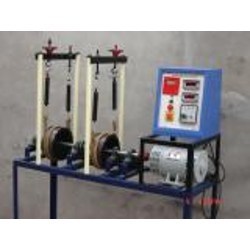
We are a leading manufacturer and supplier of Epicyclic Gear Train Apparatus. It is a motorized unit consisting of a SUN gear mounted on input shaft. Two plane gear meshes with the annular gear. These planet gears are mounted on a common arm to which output shaft is fitted. Loading arrangement is provided for loading the system and to measure holding torque.
Scope Of Experimentations:
- To measure epicyclic gear ratio between input shaft and output shaft (Actual and Theoretical)
- To measure input torque, holding torque and output torque
Utilities Required:
- Power Supply : 220 V AC, Single Phase
- Floor Area : 1.5 x 2 m
Technical Details:
- Internal Type Epicyclic Gear Train A Compact gear train (industrial)
- Motor : Variable speed DC Motor, 1 HP
- Speed Control Unit : Thyristor controlled DC Drive for varying the speed of DC motor. Rope brake arrangement to measure output torque and holding torque
- RPM Measurement : Digital RPM Indicator with proximity switch
Versatile Learning Platform for Gearing ConceptsThis experimental gear train model is specifically tailored for laboratory use in engineering institutions. It allows students to visually and practically understand the principles of epicyclic gear trains and their mechanical advantages. The variable gear ratio design accommodates numerous experiment setups, expanding its educational utility for gear mechanics.
Durable and Student-Friendly DesignConstructed with a powder-coated mild steel base and high-grade steel gears, the apparatus is built for daily lab usage. The vibration absorption mounts, combined with a hand-driven crank, offer both ease of operation and stability, minimizing wear and ensuring safety for repeated demonstrations.
FAQ's of Epicyclic Gear Train Apparatus:
Q: How is the Epicyclic Gear Train Apparatus used in laboratory experiments?
A: The apparatus is primarily hand-operated with a crank, enabling students to study gear ratios, speed, and torque transmission in real time. Analog dials measure revolutions, and the provided pulleys help track torque and speed changes during various experiment configurations.
Q: What materials are used in the construction of the gear train and its base?
A: The base plate is manufactured from mild steel with a powder-coated finish for corrosion resistance, while the gears themselves are crafted from high-grade steel, ensuring durability and precision during experiments.
Q: When would this apparatus be most beneficial for engineering students?
A: This model is best utilized during laboratory sessions focused on gear mechanisms or kinematic analysis, providing hands-on experience that reinforces academic theory on gear trains, speed ratios, and torque distribution.
Q: Where can the Epicyclic Gear Train Apparatus be installed and used?
A: The apparatus is designed for benchtop mounting, making it suitable for classroom laboratories, engineering workshops, and demonstration rooms. Its vibration absorption mounts help ensure stability during operation.
Q: What process is involved in measuring torque and speed with this apparatus?
A: Users manually turn the hand crank to operate the gear train. The apparatus measures torque and speed through analog dials connected to pulleys, allowing students to record experimental results for analysis.
Q: How does using this apparatus benefit students and instructors?
A: It enables clear, practical demonstration of complex gear mechanics, making theoretical concepts easier to grasp. Its durability and ease of use ensure consistent, hands-on learning experiences for multiple cohorts of students.







 English
 Spanish
 French
 German
 Italian
 Chinese (Simplified)
 Japanese
 Korean
 Arabic
 Portuguese


 Send Inquiry

