Product Description
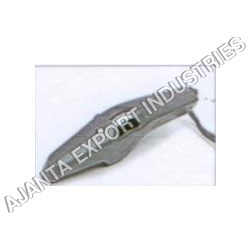
We are one of the accredited manufacturers and suppliers of a premium range ofElcometer Coating Thickness Gauge. These products are designed in compliance with the set industry standards using qualitative raw material. These products are manufactured using modern technologies and widely acclaimed by clients for its high efficiency, long lasting durability, and advanced usage.
Features:
Specifications:| Can be used in accordance with: |
| ASTM D 1186-A | ASTM G 12 |
| ASTM B 499 | ASTM A 153 |
| BS 5411-11 | BS 3900-C5-64b |
| DIN 50981 | ISO 2178 |
| ISO 2808-6Ab | SSPC-PA2 |
| Accuracy | 5% of the reading or 2.5pm/0.1 mils(whichever is the greater) |
| Minimum Substrate Thickness | 0.4 mm(16mils) |
| Minimum Area of Measurement | 30 mm(1.18) Diameter |
| Minimum Diameter for Measurement on Bar Material | 20 mm(0.8) |
| Edge Effects | Must be at least 6mm(0.24) from edge |
| Instruments Dimensions | 200x60x30 mm(7.8x2.4x1.2) |
| Certification Available | Certificate of Conformance and Calibration Certificate
|
Utilizing both magnetic induction for ferrous substrates and eddy current for non-ferrous metals, the Elcometer Coating Thickness Gauge delivers accurate, non-destructive thickness readings. Its advanced sensor technology ensures reliable results, whether in the lab or field environments, adaptable to various surface geometries.
Intuitive Calibration and ControlThe gauge supports zero, one-point, two-point, and foil calibration modes, ensuring measurement precision across different substrates. The keypad/menu-driven interface allows quick configuration, while the digital backlit LCD provides clear, immediate readings even in low-light conditions.
Superior Portability and DurabilityConstructed with stainless steel components and an ABS plastic housing, this handheld device is lightweight (1-5 kg), robust, and ideal for field use. It is powered by two AA batteries and features automatic power-off, supporting efficient, portable operation in diverse industrial environments.
FAQ's of Elcometer Coating Thickness Gauge:
Q: How do I calibrate the Elcometer Coating Thickness Gauge before measurement?
A: To calibrate, use the keypad/menu to select zero, one-point, two-point, or foil calibration modes, following the on-screen prompts for accurate setup on the substrate of interest. Calibration ensures precision across various surface types and thicknesses.
Q: What materials can this coating thickness gauge measure, and on which substrates is it compatible?
A: The gauge is designed for non-destructive thickness measurement of coatings applied to both ferrous (steel, iron) and non-ferrous (aluminum, copper) metal substrates, using magnetic induction and eddy current principles for compatibility with a wide range of coatings.
Q: When should I use the different calibration modes available on the device?
A: Zero calibration is ideal for baseline measurements, one-point and two-point calibrations enhance accuracy for specific thickness ranges, and foil calibration is used for precise calibration with reference foils. Select the calibration mode best suited to your measurement application for optimal results.
Q: Where can the Elcometer Coating Thickness Gauge be used?
A: It is suitable for use in laboratories and on location in industrial, manufacturing, or inspection environments throughout India and internationally. Its robust build and wide operating temperature and humidity range make it adaptable to various settings.
Q: What is the process for measuring coating thickness with this device?
A: Place the probe onto the coated surface, ensuring proper contact within the specified minimum measuring area and curvature limits. The device will automatically detect the substrate type and display the coating thickness on the digital LCD screen.
Q: How does this gauge benefit quality assurance or production processes?
A: By enabling fast, accurate, and non-destructive measurements, the Elcometer gauge ensures coatings meet thickness specifications, improving quality control and reducing rework or material waste across laboratory and production workflows.







 English
 Spanish
 French
 German
 Italian
 Chinese (Simplified)
 Japanese
 Korean
 Arabic
 Portuguese


 Send Inquiry

