Product Description
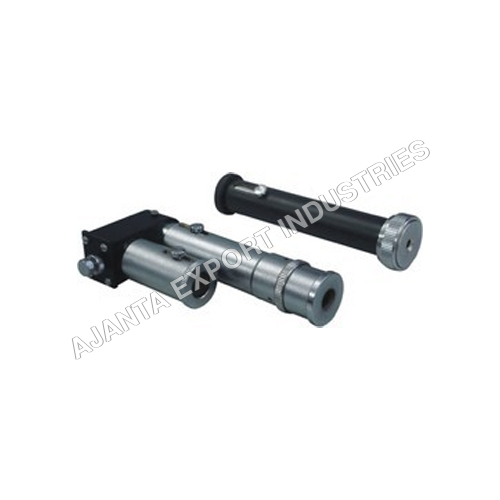
ADV-1 A complete and light weight direct vision spectroscope without wavelength scale, for observing visible radiations from 400 to 750 mm.
ADV-2 A compact visible spectroscope with wavelength scale which allows the direct reading of spectral length and employs a prism for dispersion. It is also useful for flame test of basic radicals (sodium, strontium, potassium, copper etc.) There is a single eyepiece and independent focussing tube for the graticule, which carries an index at 590mm. with "D", marked right below the scale, (corresponding to the wave length of sodium light) can be calibrated to a known light source by adjustment of knurled screw. The amount of light admitted to the spectroscope can be regulated by a variable slit, adjusted by a knurled ring round the rating tube.
Portable and Durable DesignBuilt with a polished brass body and robust glass optics, this spectroscope ensures long-term durability in demanding laboratory environments. Weighing between 2 and 10 kilograms and shaped for easy handheld use, its pocket-sized, cylindrical design fits conveniently into laboratory toolkits or educational settings, allowing for quick set-up and transport between locations.
Precise Spectrum ObservationContaining up to seven prismatic glass elements and optimized for a 10x optical magnification, the spectroscope provides clear, sharp separation of spectral lines across the visible range (400-700 nm). Manual focusing adjustments allow users to quickly tune into the finest details of a sample's spectrum, making the device suitable for both beginner and advanced scientific tasks.
FAQ's of Direct Vision Spectroscope:
Q: How is the Direct Vision Spectroscope used in laboratory analysis?
A: The spectroscope is held up to a light source so that its objective lens captures incoming light, which is then dispersed by the glass prisms inside. Viewing through the eyepiece with manual focusing adjustment, users can observe the resulting spectrum to identify distinct spectral lines for chemical, gemstone, or educational analysis.
Q: What materials and construction features make the spectroscope suitable for classroom and laboratory use?
A: The instrument features a sturdy brass body and glass optics, complemented by mild steel elements. This design ensures durability while maintaining visual clarity and resistance to wear, making it reliable for everyday scientific and educational use.
Q: When should a direct vision spectroscope be chosen over other spectral analysis tools?
A: This spectroscope is ideal for rapid visual observation of spectral lines without the need for complex setup, digital displays, or external power. Its compact, portable design is best suited for educational demonstrations, preliminary laboratory studies, and on-the-go gemstone identification.
Q: Where can the spectroscope be effectively applied?
A: The instrument excels in science classrooms during demonstrations, laboratory environments for sample analysis, and fieldwork for gemstone identification. Its lightweight, handheld design makes it adaptable across a range of scientific and educational settings.
Q: What is the process for obtaining accurate spectral separation with this spectroscope?
A: Accurate wavelength separation is achieved by adjusting the manual focusing eyepiece after aligning the instrument with the light source. The multiple prismatic glass elements disperse incoming light, allowing distinct observation of individual wavelengths through the eyepiece.
Q: How does the spectroscope benefit educational users and professionals?
A: The spectroscope's manual operation allows users to visually explore spectral properties firsthand, reinforcing foundational principles in optics and chemistry. Its precise resolution, ease of use, and portability make it a practical choice for learning and professional tasks alike.







 English
 Spanish
 French
 German
 Italian
 Chinese (Simplified)
 Japanese
 Korean
 Arabic
 Portuguese


 Send Inquiry

