Product Description
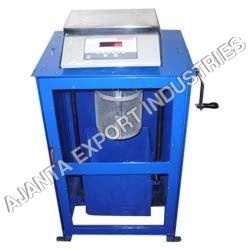
Consists of a frame mounted on coil spring to carry the cube mould and a revolving shaft provided with an eccentric.
By means of a balance weight beneath the base plate attached rigidly to the frame, the center of gravity of the whole machine, including the cube and mould, is brought either to the eccentric shaft or within a distance of 25 mm below it. Normal running speed of eccentric shaft is 12,000 ± 400 rpm.
Fitted with BELT GUARD. The motor driven by an endless belt running on a crowned pulley on the vibrating machine.
Suitable for operation on 230 V., Single phase, AC supply.
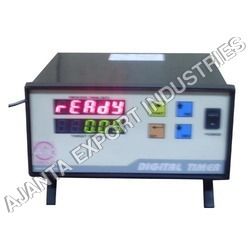
Versatile Timing for Professional EnvironmentsEngineered specifically for laboratory and hospital settings, this digital timer accommodates both count-up and countdown requirements. Multiple programmable functions make it perfect for orchestrating complex or repetitive timing tasks with ease and accuracy.
Durable Construction and Flexible Input OptionsBuilt with robust metal and plastic materials, this timer withstands rigorous laboratory use. Its input versatility-accepting both manual and digital commands-ensures seamless integration into various workflows, making it a practical solution for busy, precision-focused environments.
FAQ's of Digital Timer:
Q: How do I operate the digital timer in both countdown and count-up modes?
A: You can easily switch between countdown and count-up functions using the manual interface or digital input options. Simply select your desired mode, set the time, and start the operation according to your requirements.
Q: What is the process for programming multiple time events on this timer?
A: The timer supports multiple programmable settings. Follow the user manual to input different time programs manually or via the digital input feature, allowing you to automate and manage several timing events efficiently.
Q: Where is this digital timer most commonly used?
A: This timer is primarily used in laboratories and hospitals, where precise timing is essential for experiments, procedures, and equipment management. Its design also makes it suitable for other professional settings requiring accurate time control.
Q: What benefits does the relay output offer in laboratory applications?
A: The relay output (1 Changeover or C/O) allows the timer to control external devices, such as alarms or lab equipment, making it versatile and enhancing automation for improved workflow and safety.
Q: When should I use the manual versus the digital input method?
A: Use the manual input for quick, on-the-spot timing needs or when digital integration isn't required. Opt for the digital input when programming multiple events or integrating the timer with other control systems for more complex operations.
Q: How does the enclosure and material benefit laboratory and hospital environments?
A: The sturdy plastic enclosure and durable metal parts protect the timer from chemicals and frequent handling, ensuring long-lasting performance in demanding professional environments.







 English
 Spanish
 French
 German
 Italian
 Chinese (Simplified)
 Japanese
 Korean
 Arabic
 Portuguese


 Send Inquiry

