Product Description
Salient Features
| | Auto Range function. |
| | Selectable Speed. |
| | Direct Viscosity reading and temperature display. |
| | Big Ultra Bright Backlight LCD Display |
| | Optional - Datalog Software for LMDV-200. |
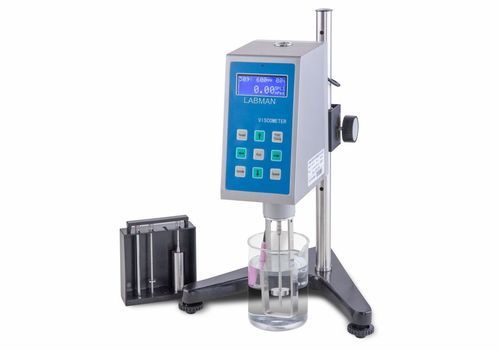
Advanced Measurement CapabilitiesThis viscometer enables precise viscosity determination for a wide variety of samples, ensuring reliable results for laboratory and industrial quality control. It supports multiple measurement units, a broad speed range (0.3-60 rpm), and direct digital readout for enhanced flexibility. The height-adjustable stand and compact design facilitate convenient operation and setup.
User-Friendly Operation & Data OutputFeaturing a microprocessor-based system, direct viscosity readout, and a bright digital LCD display, this viscometer simplifies analysis. Data can be seamlessly exported using the RS232 interface for further processing or documentation. English language support and intuitive controls make it accessible to a wide range of laboratory professionals.
Durability and AdaptabilityConstructed from robust stainless steel and high-quality plastic, the viscometer withstands daily laboratory and industrial use. It can operate efficiently in ambient temperatures between 5C and 35C and resists temperatures up to 80C, making it ideal for diverse testing needs. The innovative features enhance operational safety with auto stop and overload protection.
FAQ's of Digital Rotational Viscometer:
Q: How does the Digital Rotational Viscometer operate for viscosity measurement?
A: This viscometer determines fluid viscosity by measuring the resistance encountered by a spindle rotating in the sample. A step motor ensures stable rotation at user-selected speeds, and the microprocessor calculates and displays the viscosity instantly on the LCD screen.
Q: What types of fluids and environments can this viscometer be used for?
A: The instrument supports a viscosity range from 10 to 2,000,000 mPas, making it suitable for a wide variety of fluids in both laboratory and industrial environments. Its robust build and temperature resistance (up to 80C) allow it to handle challenging samples and conditions.
Q: When should I use different spindles provided with the viscometer?
A: Spindles L1-L4 are used to accommodate various sample viscosities. Low viscosity samples typically require smaller spindles (L1, L2), while higher viscosity samples are better measured with larger spindles (L3, L4) for optimal accuracy and stability.
Q: Where can the measurement data from the viscometer be exported or processed?
A: Measurement data can be exported via the RS232 data output interface, allowing you to connect the viscometer to a computer or data logging system for further analysis, reporting, and record-keeping.
Q: What is the minimum sample volume required, and how does it benefit the process?
A: A minimum of 20 ml of sample is required, making the device highly efficient for situations where samples are scarce or valuable, such as in research and quality control applications.
Q: How does the device ensure safety and ease of use during operation?
A: The viscometer incorporates features like auto stop function, overload protection, and a height-adjustable stand with clamp, ensuring both instrument safety and ergonomic sample handling. The digital display and easy controls further enhance user experience.
Q: What are the main benefits of using this Digital Rotational Viscometer in laboratory testing?
A: You gain accurate, repeatable viscosity measurements with minimal sample volume, automatic safety features, multiple spindle options, and straightforward data export for comprehensive analysis-making it an essential tool for consistent quality control in labs and industry.







 English
 Spanish
 French
 German
 Italian
 Chinese (Simplified)
 Japanese
 Korean
 Arabic
 Portuguese


 Send Inquiry

