Product Description
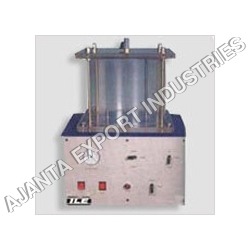
Avail from us an extensive range of De-Aired Water Apparatus. Only high grade raw material is used in the manufacturing process, sourced from trusted vendors of the market. This type of apparatus helps to produce de-aired water for soil testing apparatus. Hence, the testing time can be reduced for consolidated soil samples.
Reliable De-Airing ProcessThis apparatus employs a vacuum-assisted method, combined with a robust vacuum gauge, to efficiently eliminate dissolved gases from water. This is essential for geotechnical tests where air-free water is imperative to prevent interference with sensitive measurements. The borosilicate glass chamber resists thermal shock and chemical corrosion, ensuring both longevity and purity of your de-aired water supply.
Optimized Design for Laboratory UseWith a user-friendly PTFE stopcock and a sizable 5-liter water reservoir, this apparatus is tailored to meet the demanding needs of modern geotechnical laboratories. Its compact build and stainless steel construction allow for ease of maintenance and long-term durability. The universal voltage compatibility and ergonomic dimensions make it a versatile addition to any testing facility.
FAQ's of De-Aired Water Apparatus:
Q: How does the vacuum-assisted de-airing method work in this apparatus?
A: The vacuum-assisted method operates by evacuating air from the water chamber using the built-in vacuum gauge and pump. This process removes dissolved gases from the water, making it suitable for sensitive geotechnical laboratory testing where air content can affect results.
Q: What materials are used for the chamber and stopcock?
A: The de-aired water apparatus features a borosilicate glass chamber, known for its high resistance to thermal and chemical stress, and a PTFE (Polytetrafluoroethylene) stopcock, which provides smooth, leak-proof operation and excellent chemical resistance.
Q: When should the de-aired water apparatus be used in laboratory testing?
A: This apparatus is crucial during soil and geotechnical laboratory tests that require completely de-aired water to prevent air-related anomalies in measurement and sample behavior, such as consolidation or permeability tests.
Q: Where can this apparatus be implemented effectively?
A: It can be implemented in geotechnical and civil engineering laboratories, university research centers, and industrial material testing facilities requiring precise water quality control.
Q: What is the process for using the apparatus to obtain de-aired water?
A: Fill the borosilicate glass chamber with water, close the PTFE stopcock, and activate the vacuum pump. Monitor the vacuum gauge until the desired pressure (0-760 mmHg) is achieved and maintained for adequate de-airing. Once complete, de-aired water can be dispensed through the 6 mm outlet nozzle.
Q: What are the main benefits of using this de-aired water apparatus?
A: The main benefits include a reliable supply of air-free water, enhanced accuracy in sensitive soil tests, durable and easy-to-clean materials, and user-friendly operation designed for efficient laboratory workflow.
Q: Is the apparatus suitable for a range of operating temperatures and voltages?
A: Yes, it is suitable for operating in temperatures from ambient to 60C and supports a broad voltage range of 220-440V, making it adaptable to various laboratory environments in India.







 English
 Spanish
 French
 German
 Italian
 Chinese (Simplified)
 Japanese
 Korean
 Arabic
 Portuguese


 Send Inquiry

