Product Description
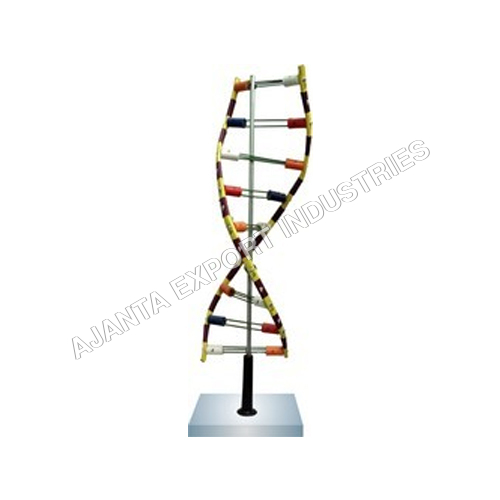
Easy to construct the three dimensional model of DNA. Emphasizing the base pair sequence and function of DNA, the sturdy, colorful bases snap together in the correct sequence, and the pairs attach to a center rod representing hydrogen bonds. Two flexible strands signifying alternating pentose and phosphate units attach to the end of each pair, forming the double helix. Once completed the, the model can be rotated on its sturdy base. Includes enough materials to construct one models, a printed instruction manual. Engaging Educational DemonstrationsPerfect for classrooms and laboratories, the D.N.A Model Kit brings molecular biology to life. Its color-coded parts and demonstration-scale size make it simple for students and educators to visualize complex DNA structures and interactions. Ideal for demonstrations, this model enhances understanding through interactive, hands-on exploration.
Durable and Reusable ConstructionCrafted from high-quality PVC and metal, this DNA model offers exceptional durability, ensuring repeated use for classes and sessions. The easy-to-clean design and sturdy boxed packing facilitate effortless maintenance and safe storage, making it a reliable educational asset.
FAQ's of D.N.A Model Kit:
Q: How do I assemble the D.N.A Model Kit?
A: Begin by unpacking all components from the boxed set. Follow the included instructions, matching color-coded pieces to form the double helix structure. Each part represents a specific portion, such as base pairs or the sugar-phosphate backbone, and snaps securely into place.
Q: What educational benefits does the kit offer?
A: The kit provides a clear, tangible understanding of DNA structure and function. It aids students and trainees in grasping key molecular concepts, fostering engagement and knowledge retention through interactive learning.
Q: When is the D.N.A Model Kit most effectively used?
A: It is ideally utilized during biology lessons, laboratory demonstrations, and educational workshops in schools, colleges, and medical institutions to visually illustrate DNA's double helix structure and its biological significance.
Q: Where can the D.N.A Model Kit be used?
A: The model kit is designed for a variety of educational environments including classrooms, science labs, and hospital training areas. Its portability allows for convenient transport and usage in multiple locations.
Q: What is the recommended maintenance process for this model?
A: To ensure longevity, clean the parts with a soft, damp cloth after use. Store all components in the provided box in a dry environment to preserve quality and prevent damage.
Q: How does the color-coding improve learning?
A: Color-coded components differentiate base pairs and the sugar-phosphate backbone, making it easier for learners to identify and comprehend the DNA's structural features during assembly and demonstration.







 English
 Spanish
 French
 German
 Italian
 Chinese (Simplified)
 Japanese
 Korean
 Arabic
 Portuguese




 Send Inquiry

