Product Description
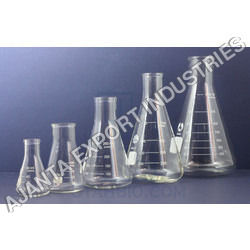
An Erlenmeyer, also known as a conical flask, is a widely used type of laboratory flask which features a flat bottom, a conical body, and a cylindrical neck. It is named after the German chemist Emil Erlenmeyer, who created it in 1861.
The Conical Flask is usually marked on the side (graduated) to indicate the approximate volume of contents, and has a spot of ground glass or enamel where it can be labeled with a pencil. It differs from the beaker in its tapered body and narrow neck.
Precision and Versatility in Laboratory ApplicationsCrafted from premium borosilicate glass, these conical flasks are ideal for chemical analysis, sample storage, and laboratory experiments. The narrow neck with a lip and clear white enamel graduations allows for accurate measurement and easy pouring. Their chemical and thermal resistance make them indispensable in environments requiring reliable performance under varying conditions.
User-Friendly Design Promotes Safe HandlingThe wide, sturdy base of each flask enhances stability, effectively reducing the risk of accidental spills. Despite being lightweight (5-25 grams), their robust glass construction ensures long-term durability and consistent results, while remaining easy to clean and reuse for multiple lab procedures.
Adaptable Storage and Packaging OptionsAvailable in a broad range of capacities from 0.05 to 2.0 liters and packaged according to your requirements, these flasks cater to both small-scale research settings and large institutional laboratories. Their transparent design provides immediate visual monitoring of contents, streamlining experimental workflows.
FAQ's of Conical Flask:
Q: How should I properly use the conical flask for laboratory experiments?
A: To use the flask, add your sample or reagents through the narrow neck, which reduces evaporation and contamination risk. Mix by swirling gently. Always leverage the graduation markings for approximate measurements (5% accuracy) and handle with care to maintain long-term durability.
Q: What are the key benefits of using a borosilicate glass conical flask in chemical analysis?
A: Borosilicate glass is highly resistant to thermal shock and chemicals, making it ideal for reactions involving acids, bases, or solvents. The transparency allows for visual monitoring and the conical shape aids in efficient mixing and sample retrieval.
Q: When is it safe to autoclave this conical flask, and at what maximum temperature?
A: The conical flask can be safely autoclaved prior to use for disinfection or sterilization, as it withstands temperatures up to 250C. Ensure the flask is clean and not tightly capped during the process to prevent pressure buildup.
Q: Where is this flask best suited for use, and are there industry-specific recommendations?
A: This conical flask is well-suited for laboratories in educational, pharmaceutical, and industrial settings. Its chemical resistance and stability make it suitable for general lab work, solution preparation, titration, and sample storage.
Q: What is the process for ensuring chemical compatibility before using the flask?
A: Always verify that your intended chemicals are compatible with borosilicate glass. Most common acids, bases, and solvents can be safely handled, but extremely strong hydrofluoric acid or alkaline substances may cause etching over time.
Q: Is the flask reusable, and how should it be maintained for repeated use?
A: Yes, this conical flask is reusable. After every use, thoroughly wash it with a suitable laboratory detergent and rinse with distilled water. It can be autoclaved for sterilization, ensuring safe and uncontaminated future experiments.
Q: What packaging options are available for bulk orders and how are the flasks protected during transit?
A: Flasks are available individually packed or in bulk cartons, with protective packaging to minimize risk of breakage. Contact your distributor or exporter in India for packing details tailored to your order size and shipping needs.






 English
 Spanish
 French
 German
 Italian
 Chinese (Simplified)
 Japanese
 Korean
 Arabic
 Portuguese


 Send Inquiry

