Product Description
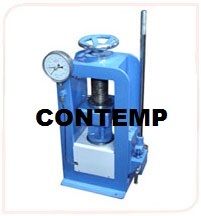
Compression Testing Machine 100 ton With Masta Guage
Our compression testing equipment have designed so that it efficiently meets the need to test concrete cube for its compressive strength. Compression Testing Machine equipment is the most simple, economical and reliable means of testing. Following are some features which has made it a demanding product in the market:
Simple in operation
Easy to use
Assured Testing PrecisionWith a measuring accuracy of Class 1.0, this compression testing machine ensures reliable and reproducible results for your quality assurance needs. The analog Masta gauge, calibrated as per IS:1828 and BS:1610, enables precise monitoring of test loads up to 100 tons.
Engineered for Durability and SafetyConstructed from heavy-duty steel and protected with a powder-coated or enamel finish, the machine is built to withstand rigorous laboratory use. Its integrated overload protection valve provides safety by automatically limiting excessive pressure during operation.
User-Friendly Manual OperationDesigned for manual hand operation, the machine includes a hydraulic hand pump and a dial-type gauge. This enables seamless use without external power, making it ideal for field testing or laboratories without consistent power supply. Essential components, such as spacer blocks, are supplied for flexible testing of various specimen sizes.
FAQ's of Compression Testing Machine 100 ton With Masta Guage:
Q: How does the Compression Testing Machine achieve measuring accuracy as per IS:1828 / BS:1610 standards?
A: The machine incorporates a high-precision analog Masta gauge, which is calibrated to Class 1.0 accuracy according to IS:1828 and BS:1610. This ensures that each test produces results with minimal deviation, conforming to industry standards for measuring compressive strength.
Q: What types of specimens can I test with this machine?
A: This equipment is specifically designed for testing the compressive strength of concrete cubes and cylinders. Spacer blocks are provided to accommodate testing of various specimen dimensions typically used in construction quality control.
Q: When is manual hand operation advantageous compared to powered models?
A: Manual operation is ideal when testing needs to be performed in environments where electric power may not be consistently available or for field applications. The included hand pump provides full control over load application, ensuring convenience without relying on external power sources.
Q: Where should this compression testing machine be installed for optimal performance?
A: For best performance, the machine should be installed in a stable laboratory environment with ambient temperatures ranging from 0C to 50C. A flat surface capable of supporting its approximate dimensions (1200 x 600 x 1200 mm) and weight is recommended.
Q: What is the process for using the compression testing machine safely?
A: To operate safely, place the test specimen and appropriate spacer blocks on the platen, engage the hydraulic pump manually, and observe the pressure reading on the dial. The built-in overload protection valve will automatically release excess pressure to prevent accidental damage or hazards.
Q: How does the overload protection valve benefit users during operation?
A: The overload protection valve serves as a safety feature by automatically relieving pressure if the load exceeds the machine's rated capacity, thereby preventing both user injury and damage to the equipment during testing.







 English
 Spanish
 French
 German
 Italian
 Chinese (Simplified)
 Japanese
 Korean
 Arabic
 Portuguese


 Send Inquiry

