Product Description
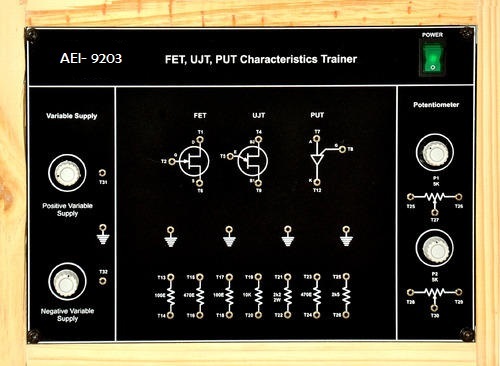
AEI-9203 is a Basic Electronics Trainer System to understand Characteristics of FET, UJT and PUT. Various functional block diagrams are provided on-board for Teaching/Training.This Trainer provides with various Test Points to Measure the Parameters on Multimeter.
Features:
- Functional blocks indicated on board mimic
- Input-output and Test Points provided onboard
- Built in DC Power Supply
- Fully documented operating manual
- All ICs are mounted on IC Sockets.
- Bare board Tested Glass Epoxy SMOBC PCB is used.
- Onboard variable Positive and Negative power supply
- Onboard variable and fixed resistances
- Attractive Wooden enclosures of Light weight
- Australian Pine Wood. Compact Size
- 2 Year Warranty
Specifications:
| Potentiometers | 2 Nos. Of 5KQ |
| Resistances | 7 Nos. |
| Interconnections | 2mm Banana Socket |
| Test Points | 32 nos |
| Power Supply | 230 V 10%, 50/60 Hz |
| Power Consumption | 3 VA approximately |
| Dimensions (mm) | W 190xD 279xH 95 |
| Weight | 2.8 Kg. approximately |
| Operating Conditions | 0-40 C, 80% RH |
| Variable power supply | 0-15V Positive |
| 0-15V Negative |
| On board circuits | FET configuration |
| UJT configuration |
| PUT configuration |
Purpose-Built for Transistor CharacterizationThe AEI-9203 trainer is purpose-built for studying the specific characteristics of FETs, UJTs, and PUTs. It simplifies practical sessions by incorporating inbuilt, pre-mounted components, allowing students and educators to focus on experimentation rather than assembly. All connections are straightforward, with test points and labeled sockets enhancing accuracy and convenience.
Enhanced Safety and DurabilityConstructed from mild steel and equipped with fuse protection, the trainer is designed with safety and longevity in mind. High-quality, permanent panel printing ensures that labels remain intact through years of use, making it a reliable tool for continuous laboratory application.
Comprehensive Student SupportThe AEI-9203 includes a detailed instruction manual, inbuilt power supply, standardized sockets, and patch cords, making it accessible for students of varying skill levels. Its clear labeling and standard lab accuracy enable easy usage and accurate results, bridging the gap between theoretical learning and practical application.
FAQ's of Characteristics of FET,UJT & PUT Trainer - AEI-9203:
Q: How can students use the AEI-9203 Trainer to study transistor characteristics?
A: Students can directly connect test instruments via 4mm safety sockets and use the provided test points to plot the input and output characteristics of FET, UJT, and PUT. The pre-mounted components and manual switches simplify the measurement process, enabling students to analyze and calculate all relevant parameters easily.
Q: What components and accessories are included with the AEI-9203 Trainer?
A: The trainer comes equipped with inbuilt FET, UJT, and PUT transistors, patch cords, a clear instruction manual, labeled test points, and all connections via 2mm sockets. It is designed for immediate use in laboratory environments.
Q: When is it appropriate to use an external meter with this trainer?
A: External meters can be connected through the dedicated 4mm safety sockets whenever precise measurements or graphical plotting are required, complementing the onboard test features and ensuring experimental accuracy.
Q: Where is this trainer most effectively utilized?
A: The AEI-9203 is ideal for technical institutes, engineering colleges, and laboratory environments where hands-on learning of FET, UJT, and PUT characteristics is essential. Its robust design makes it suitable for regular institutional use.
Q: What benefits does the clear labeling and panel marking provide?
A: High-quality, permanent panel printing and clear labeling ensure that all controls, sockets, and test points are easily identifiable, reducing setup errors and allowing users to conduct experiments more efficiently.
Q: How does the trainer ensure user safety during operation?
A: The trainer incorporates fuse protection for the power supply and utilizes standard quality electronic components. This ensures safe operation during experiments, protecting users and equipment from electrical faults.







 English
 Spanish
 French
 German
 Italian
 Chinese (Simplified)
 Japanese
 Korean
 Arabic
 Portuguese


 Send Inquiry

