Product Description
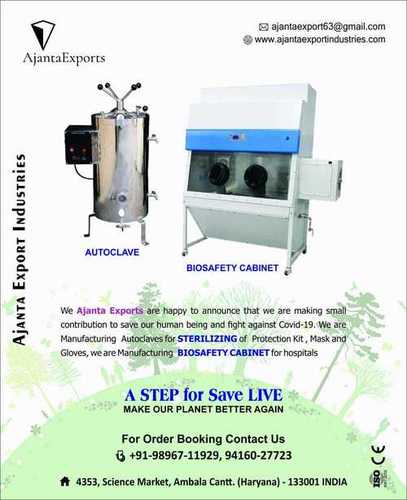
We have domain expertise in offering an extensive range of Class I Biological Safety Cabinet, which is available in three different modules. Our range of Class I Bio Safety Cabinets meets the laboratory requirements for life science research, clinical or industrial applications. These Class I Biosafety Cabinets are manufactured using stainless steel for easy cleaning and maintenance and excellent powder coating finish helps to prevent microbial or bacterial growth.
| Cabinet Material | Stainless Steel |
| Main Filter | HEPA Filter |
| Noise Level | Less than 65 db |
|
| No of HEPA Filter | 1 |
Advanced Biosafety FeaturesThe Class II, Type A2 Biosafety Cabinet is engineered for maximum operator, product, and environmental protection. Key elements include a high-efficiency particulate air (HEPA) filter, delivering 99.99% filtration at 0.3 microns, and real-time operational monitoring. Pressure interlocks and door lock mechanisms further safeguard users during sensitive procedures. This equipment is essential for research laboratories handling infectious or hazardous materials.
Efficient Autoclave PerformanceDesigned for laboratory sterilization, the Autoclave offers reliable, semi-automatic operation. With rapid cycle times (20-40 minutes) and a generous 30-liter chamber, it meets the high-throughput needs of modern labs. Digital controls and automated safety systems ensure precise temperature regulation and user protection. The device is mounted on caster wheels for maneuverability within the facility.
User-Friendly Operation and MaintenanceOperating the cabinet and autoclave is streamlined through clear digital touch screen panels, intuitive alarms, and helpful UV timer features. Adjustable legs and solid construction enable stability, while the ergonomic design facilitates easy routine maintenance. These features ensure equipment longevity and continuous, safe usage across a broad range of laboratory scenarios.
FAQ's of Biosafety Cabinet And Autoclave:
Q: How does the biosafety cabinet provide protection for laboratory personnel and samples?
A: The Class II, Type A2 biosafety cabinet uses a HEPA filter with 99.99% efficiency at 0.3 micron to trap particles. It maintains a laminar airflow, safeguards the work area, and features safety interlocks and a UV lamp for added sterilization, protecting both users and samples.
Q: What is the typical sterilization process in the autoclave, and how long does it take?
A: The autoclave utilizes electric heating to sterilize instruments at temperatures up to 134C, with cycle times ranging from 20 to 40 minutes. Steam penetrates materials within the 30-liter chamber, ensuring effective elimination of microorganisms during each cycle.
Q: When should the UV lamp and timer be used in the biosafety cabinet?
A: The UV lamp, controlled by the built-in timer, should be activated before and after working with samples to disinfect the workspace. Always ensure the sash is closed and no personnel are present during UV sterilization to prevent exposure.
Q: Where should the equipment be installed for optimal performance and safety?
A: Place the biosafety cabinet and autoclave in a well-ventilated laboratory, away from direct sunlight, high-traffic areas, and moisture. The cabinet is stationary, while the autoclave's caster wheels allow you to move it as needed within the lab.
Q: What are the benefits of using a ducted or recirculating exhaust system in the biosafety cabinet?
A: A ducted exhaust system provides external venting for hazardous materials, while a recirculating option filters and returns air to the lab. Both configurations maximize containment and flexibility, adapting to different safety requirements.
Q: How is real-time operation and digital display beneficial for users?
A: Digital displays and real-time monitoring allow operators to track and adjust controls, view alarm notifications, and ensure critical parameters such as temperature and airflow are maintained for safe and accurate results.
Q: What are the maintenance and storage recommendations for this equipment?
A: Regularly clean the stainless steel interior and check HEPA filters and safety features. Store the devices in a cool, dry area when not in use, following the manufacturer's instructions to ensure longstanding performance and safety.







 English
 Spanish
 French
 German
 Italian
 Chinese (Simplified)
 Japanese
 Korean
 Arabic
 Portuguese


 Send Inquiry

