Product Description
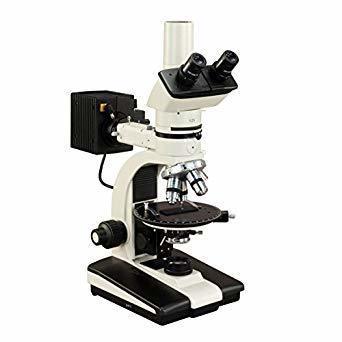
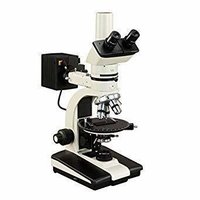
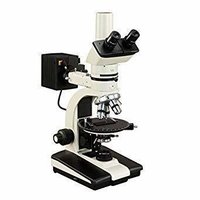
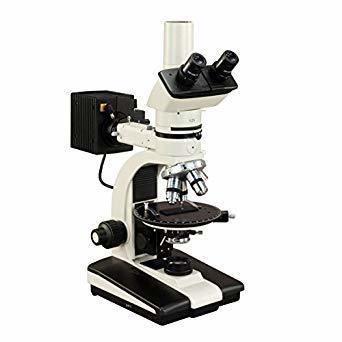
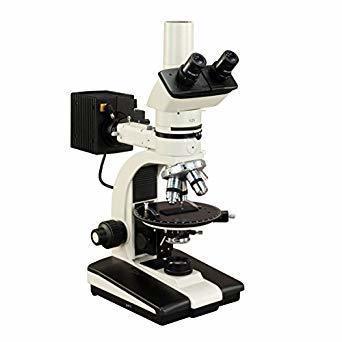
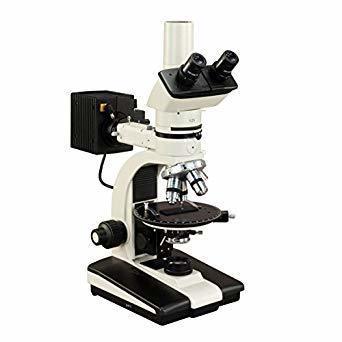
Details- Nosepieces: Quadruple, objective center adjustable; Objectives: DIN strain free achromatic - 4X/0.10 160/- - 10X/0.25 160/- - 25X/0.40 160/0.17 - 40X/0.65 160/0.17(s) - 63X/0.85 160/0.17(s) - Plan 25X/0.40 160/0 - Plan 40X/0.65 160/0 (s) - Plan 63X/0.85 160/0 (s); Condenser: NA1.30 Abbe Condenser with iris diaphragm, condenser center adjustable, top lens can be swing out of the light path
- Stage: - Circular, diameter 160 mm - Rotatable, with 360degrees; angle graduations and a vernier scale, accurate to 0.1degrees - Mechanical specimen holder: range 32mm x 27mm, removable; Polarizer - For transmitted light: mounted beneath the condenser, rotatable with 360 degree angle graduations - For reflected light: fixed in the tube of EPI light path; Analyzer: Slide in and out of the light path, 0 degrees to 90 degrees graduation
- Bertrand lens: Switch in and out of the light path, center adjustable, focus adjustable; Compensators - Quarter-wave plate (1/4 lambda plate) - Tint plate (1 lambda plate) - Quartz wedge (Q plate); Focus adjustment: Coaxial coarse and fine adjusting knobs on both sides
- Illumination - Transmitted light: Halogen lamp, brightness adjustable, 12V/20W - Reflected light: Halogen lamp, brightness adjustable, 12V/50W; Filters - Blue (for transmitted light) - Green (for reflected light); Power supply: 90V - 265V; 5-year warranty against manufacturing defects
Advanced Polarizing SystemEquipped with a built-in analyzer and polarizer, the microscope provides precise control over polarized light, enabling accurate identification of minerals and ore textures. The centerable Bertrand lens allows for advanced conoscopic observations, crucial for analyzing crystal structures and interference patterns.
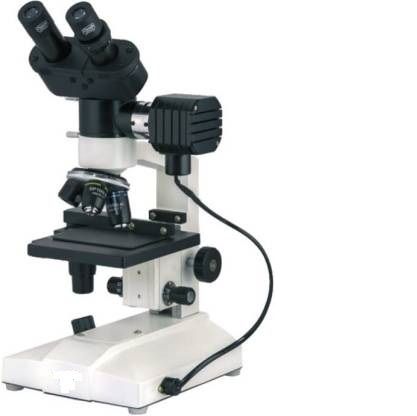
Ergonomic & Durable DesignThe 45 inclined, binocular viewing head with a 360 rotation ensures comfortable operation. The chemically resistant epoxy coating increases durability, while the robust mechanical construction and dust cover ensure longevity and minimal maintenance, making it ideal for rigorous research environments.
Versatile ApplicationsTailored for geological research, mineralogy, petrography, and ore sample studies, this microscope supports magnifications from 40x to 400x as standard, expandable to 1000x. Its equipped with strain-free optics, mechanical stage movement, and wide field eyepieces, addressing diverse professional and academic research needs.
FAQs of Binocular Polarizing Petrological Ore Microscope:
Q: How does the built-in polarizing system benefit geological sample analysis?
A: The integrated analyzer and polarizer allow precise manipulation of polarized light, helping reveal mineral structures, optical properties, and birefringence, which are essential for accurate identification and analysis of geological and ore samples.
Q: What is the process for conducting petrographic observations with this microscope?
A: To observe petrographic samples, prepare thin sections and place them on the circular rotatable stage. Use the polarizer and analyzer to study optical properties, and employ the Bertrand lens for conoscopic analysis to view interference patterns and crystal orientations.
Q: Where can this microscope be used effectively?
A: This microscope is ideal for academic laboratories, geological research centers, mining companies, mineralogy departments, and institutions involved in ore and petrographic investigations. Its robust build supports both educational and professional environments.
Q: What are the main usage advantages of the 360 rotatable and centerable stage?
A: A 360 rotatable, centerable stage enables precise orientation and examination of samples from any angle, facilitating comprehensive study and easy alignment for complex mineral or ore specimens.
Q: When should I use the Bertrand lens for observation?
A: Utilize the centerable Bertrand lens when performing conoscopic observations, which are required to analyze interference figures and optic axis characteristics of anisotropic minerals.
Q: How do the magnification options enhance research flexibility?
A: With standard magnifications of 40x, 100x, and 400xexpandable up to 1000x with additional accessoriesresearchers can adjust the microscope to suit both overview and detailed studies, improving observation versatility across different sample types.
Q: What type of maintenance and spare parts are provided with the microscope?
A: The microscope comes with spare eyepieces, a replacement lamp, fuse, and a dust cover. The sturdy design and included accessories ensure longevity and easy maintenance during extended research use.







 English
 Spanish
 French
 German
 Italian
 Chinese (Simplified)
 Japanese
 Korean
 Arabic
 Portuguese


 Send Inquiry

