Product Description
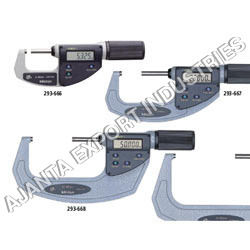
The Quickmike provides a speedy spindle feed of 10 mm per thimble rotation as compared to the conventional micrometer with 0.5 mm per rotation. Its wide 30 mm measuring range allows various workpieces with different shapes to be measured quickly.Features:- Non-rotating spindle and the new ratchet friction thimble
- Speedy spindle feed of 10 mm/rev
- With absolute linear scale
- IP54 dust/water protection (when not connected with data output cable)
- With SPC data output
- With a standard bar to set the origin point (for models with a range over 30 mm)
Technical Data:
- Accuracy: Refer to the list of specifications
- Resolution: 0.001 mm or .00005"/0.001 mm
- Flatness: 0.3m
- Parallelism: 2m for models up to 80mm
- 3m for models up to 105 mm
- Measuring faces: Carbide tipped
- Display: LCD
- Battery: SR44 (1 pc.), 938882
- Battery life: Approx. 3 years under normal use
- Dust/Water protection level: IP54
Function:- Origin-set, Zero-setting, Power ON/OFF, Data hold, Data output, inch/mm conversion (inch/mm models)
- Alarm: Low voltage, Counting value composition error
Optional Accessory:- 937387: SPC cable (1 m)
- 965013: SPC cable (2 m)
Specifications:| Range | Order No. | Accuracy |
| 0-30 mm | 293-666
293-661-10* | 2m
2m |
| 25-55 mm | 293-667 | 2m |
| 50-80 mm | 293-668 | 3m |
| 75-105 mm | 293-669 | 3m |
| Inch/ Metric |
|
|
|
| Range | Order No. | Accuracy | Measuring force |
| 0-1.2 | 293-667 | .0001 | 0.5N - 2.5N |
| 1-2.2 | 293-667 | .0001 | 2N 10N |
| 2-3.2 | 293-668 | .00015 | 0.5N 2.5N |
| 3-4.2 | 293-669 | .00015 | 2N - 10N
|
Engineered specifically for laboratory applications, the Absolute Digimatic Micrometer provides precise measurement capabilities essential for scientific and industrial settings. Its advanced digital mechanism ensures quick and reliable readings, enhancing efficiency and accuracy in measurement-intensive tasks.
Rugged Stainless Steel ConstructionManufactured using premium-grade stainless steel, this digimatic micrometer offers superior durability and resistance to corrosion. The robust build protects the device from environmental wear, extending its lifespan and ensuring consistent performance in demanding laboratory conditions.
FAQ's of Absolute Digimatic Micrometers:
Q: How do I operate the Absolute Digimatic Micrometer for laboratory measurements?
A: To use the Absolute Digimatic Micrometer, carefully place the object between the spindle and anvil, then gently rotate the ratchet stop until proper contact is made. The digital display provides an instant, precise measurement, which is ideal for repeatable laboratory tasks requiring consistency and accuracy.
Q: What are the key benefits of using a stainless steel digimatic micrometer in laboratory settings?
A: Stainless steel construction offers resistance to rust and mechanical wear, ensuring long-term accuracy. The digimatic feature allows for easy and error-free digital readings, making it highly beneficial for precise laboratory measurement processes.
Q: When should I calibrate the Absolute Digimatic Micrometer?
A: Calibration should be performed periodically-typically every 6-12 months, or before commencing critical measurement tasks. Frequent calibration maintains the micrometer's accuracy, especially in rigorous laboratory environments.
Q: Where can I purchase this Absolute Digimatic Micrometer in India?
A: You can acquire the Absolute Digimatic Micrometer from authorized distributors, exporters, manufacturers, suppliers, and traders across India. Ensure you choose a reputable seller for genuine products and after-sales support.
Q: What is the correct process for measuring with this micrometer?
A: First, ensure the micrometer is clean and calibrated. Place your sample between the anvil and spindle, use the ratchet to close gently, and read the measurement value on the digital display. Always avoid overtightening to protect both the tool and the sample.
Q: What is the weight and why is it important for laboratory use?
A: The micrometer weighs 0.275 kilograms, offering a balance between sturdiness and ease of handling. This manageable weight ensures stable operation and reduces operator fatigue during repeated laboratory measurements.
Q: How does using this micrometer improve the laboratory measurement process?
A: Its digital accuracy reduces human error, speeds up data collection, and ensures repeatable results. The stainless steel design adds to its durability, making it a reliable choice for laboratories requiring precise and consistent measurements.







 English
 Spanish
 French
 German
 Italian
 Chinese (Simplified)
 Japanese
 Korean
 Arabic
 Portuguese


 Send Inquiry

