Product Description
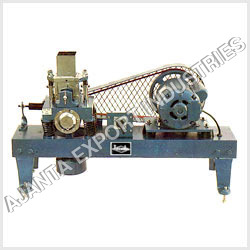
In order to cater to the variegated demands of the customers, we are engaged in bringing forth technically advanced Vibration Machines. Designed using premium-grade raw material, advanced machinery and latest techniques, the range is widely used for preparing mortar cubes. This helps in determining compression strength of hardened, low heat, blast furnace & high alumina portable cement.
Specifications:
- Revolving eccentric shaft
- Mounted over coiled springs
- Controlled programmer frequency: 12,000 ± 400 cycles per minute
- Center of gravity falls at the center of the shaft or within 25 mm below it
Major attributes:
- Simple design
- Easy assembly & dismantling of molds
- Suitable for operation on 230 V, 50 Hz & single-phase AC supply
Engineered for Durability and VersatilityOur Vibration Machines utilize premium mild steel and cast iron constructions to ensure longevity, whether deployed in demanding stone crusher plants or precise laboratory environments. With flexible power options and amplitude settings, they adapt seamlessly to varied industrial tasks. The paint-coated finish enhances resistance to harsh conditions, providing reliable performance over extended use.
Optimized Performance for Heavy-Duty ApplicationsDriven by powerful motors ranging from 2.2 kW to 5.5 kW, these machines deliver consistent vibration at 1440 rpm, essential for efficient sand screening and material separation. The manual operation method enables precise control, while the foot mounting design ensures stability during operation. These attributes make them indispensable equipment for industrial facilities requiring dependable vibratory solutions.
FAQ's of Vibration Machines:
Q: How do vibration machines enhance the sand screening process in industrial setups?
A: Vibration machines efficiently separate particles by rapidly oscillating material across a screen, facilitating the sorting of sand and aggregates in industrial applications. Their consistent amplitude and frequency ensure even movement and optimal particle separation, improving overall productivity and screening accuracy.
Q: What are the main benefits of using mild steel and cast iron for these machines?
A: Mild steel and cast iron are chosen for their high strength and resistance to wear, which is crucial for industrial environments. These materials provide durability, withstand vibrations and impact, and extend the equipment's service life, ensuring minimal downtime and long-term reliability.
Q: When is a single-phase versus a three-phase power supply recommended for these machines?
A: A single-phase supply is suitable for smaller loads, typically in laboratory or light-duty environments. Three-phase supply is recommended for heavy industrial applications that demand higher power (up to 5.5 kW) and continuous operation, such as in stone crusher plants or large-scale sand screening units.
Q: Where can these vibration machines be installed within an industrial facility?
A: The machines are designed for foot mounting, making them adaptable to varied site arrangements. They can be securely installed in sand screening stations, near stone crushers, or specific laboratory platforms, wherever steady vibratory performance is required.
Q: What is the typical process of operating these vibration machines?
A: Operation is manual; users set up the machine, ensure correct mounting, connect it to a proper power supply (220V or 380V), and adjust amplitude as needed. Upon activation, the machine vibrates at the designated frequency to perform efficient material separation or testing.
Q: How does the vibration frequency of 1440 rpm benefit industrial applications?
A: A vibration frequency of 1440 rpm provides the optimal balance between throughput and separation efficiency in industrial processes. This frequency ensures rapid, uniform movement of materials, which is critical for effective particle classification and screening.
Q: What advantages does a paint-coated surface finish offer for these machines in industrial use?
A: A paint-coated finish shields the structure from corrosion, environmental hazards, and abrasive materials commonly encountered in industrial settings. This protective layer preserves the machine's integrity and extends its lifespan, resulting in better value for operators.







 English
 Spanish
 French
 German
 Italian
 Chinese (Simplified)
 Japanese
 Korean
 Arabic
 Portuguese



 Send Inquiry

