Product Description
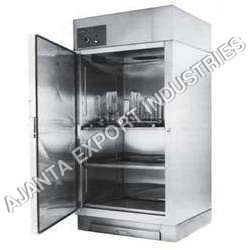
- Specially designed for all type of glass ware drying
- Triple walled in construction with inner made of 304 stainless steel & exterior G.I powder coated shade in regular model.
- Inner 316L S.S mirror finish and exterior also 304 S.S matt finish in GMP MODEL.
- Heating element clamped two sides for prefect drying no elements at bottom
- Air circulation being performed by motorized blower
- Selection of controller solid state DIGITAL controller or microprocessor PID controller with printer port.
| Cat. No. | Chamber Inner Size | Capacity | Temp. range
|
| EI -25/ A | 18X18X20 | 3.75 CFT/ 106 LTRS | 5c above ambient to 200c |
| AEI -26/ B | 24X24X24 | 8 CFT/228 LTRS | 5c above ambient to 200c |
| AEI -27/ C | 24X24X36 | 12 CFT/ 342 LTRS | 5c above ambient to 200c |
| AEI -28/D | 18X18X20 | 3.75 CFT/ 106 LTRS | 50c to 300c |
| AEI -29/E | 24X24X24 | 8 CFT/ 228 LTRS | 50c to 300c |
| AEI -30/F | 2424X36 | 12 CFT/342 LTRS | 50c to 300c |
High-Efficiency Laboratory Glassware DryingThis glassware dryer delivers rapid and uniform drying, thanks to its forced air circulation and adjustable temperature settings. Engineered with laboratory-grade stainless steel and insulated features, it is ideal for handling all standard glassware safely and efficiently. Its corrosion-resistant construction ensures reliability even with frequent usage in demanding research or industrial environments.
Intuitive Controls and Durable DesignDesigned for ease of use, the glassware dryer features clear analog display and thermostatic control, providing accurate temperature regulation within 2C. The removable shelves and wide glass window allow for flexible operation and easy monitoring, while its robust structure and protective thermal safety mechanisms enhance both usability and durability.
FAQ's of Glassware Dryer :
Q: How do I operate the Glassware Dryer for optimal drying results?
A: Begin by arranging your glassware on the removable and adjustable shelves, ensuring adequate spacing for airflow. Close the insulated door securely, set the desired temperature (up to 80C) on the analog control, and switch on the power. The forced air blower ensures even drying. Monitor progress through the glass window and use the overheat thermostat for added safety.
Q: What types of glassware can be used with this laboratory dryer?
A: This dryer is suitable for all standard laboratory glassware, including beakers, flasks, cylinders, pipettes, and more. The adjustable shelves can accommodate a variety of glass item sizes, making it versatile for different laboratory applications.
Q: When should I use the overheat safety thermostat?
A: The overheat safety thermostat is designed as an automatic protective feature. It activates if the internal temperature exceeds the set threshold, preventing damage to glassware or the dryer. Regular use does not require manual intervention, but periodic function checks are advisable for safety compliance.
Q: Where is the best location to install the Glassware Dryer in my laboratory?
A: Place the dryer on a stable, level surface with adequate ventilation around it. Ensure it is installed near a standard 220-240V power outlet and avoid areas with excessive moisture or direct sunlight to maintain optimal performance and equipment longevity.
Q: What is the process for cleaning and maintaining the Glassware Dryer?
A: Turn off and unplug the dryer before cleaning. Wipe interior stainless steel surfaces and removable shelves with a soft, damp cloth. The outer cabinet should be cleaned with mild detergent and water. Regularly check and clean any air vents to maintain efficient airflow and longevity of the blower.
Q: How does forced air circulation benefit the drying of glassware?
A: Forced air circulation, achieved through a fitted blower, ensures uniform heat distribution and consistent drying throughout the chamber. This reduces drying time and helps prevent condensation, safeguarding the integrity of delicate glass instruments.







 English
 Spanish
 French
 German
 Italian
 Chinese (Simplified)
 Japanese
 Korean
 Arabic
 Portuguese


 Send Inquiry

